
The Beatles’ 1962–1966 (better known as the “Red Album”) is a career-spanning compilation released as a double LP in 1973, covering the band’s official output from their 1962 debut through mid-1966.
It launched alongside its sister set, the “Blue Album” (1967–1970), giving new listeners an instant shortcut through the catalogue, and giving long-time fans an official, Apple-approved alternative to the flood of unofficial compilations.
What The Beatles “Red Album” Actually Is
1962–1966 was compiled under Apple’s business era in the early 1970s (with Allen Klein credited as compiler) and issued by Apple/EMI (and Apple/Capitol in the US). The original 1973 edition sticks to Lennon–McCartney originals only: no cover versions, and no George Harrison songs, even though Harrison was writing major material by 1965–66.
That limitation is a big reason the album stayed popular but also felt incomplete to serious fans. It does what it says on the tin (hit-heavy Beatles 1962–66), but it trims away key parts of the story.
Key Facts
- Title: 1962–1966 (aka “The Red Album”)
- Original Release: 2 April 1973 (US) / 19 April 1973 (UK)
- Scope: Beatles recordings released 1962–1966 (as selected for the compilation)
- Original Format: 2×LP (26 tracks)
- Label: Apple
- Studios Credited: EMI Studios, London; Pathé Marconi Studios, Paris
- Producer Credited: George Martin
- Compiler Credited: Allen Klein
- Expanded Edition: 10 November 2023 (now 38 tracks; 3×LP and 2×CD editions)
Why It Was Released In 1973
The Red and Blue albums did not appear in a vacuum. By 1972, a high-profile bootleg called “Alpha Omega” was being sold via aggressive advertising, and it put real pressure on Apple/EMI to get an official, well-packaged Beatles hits set into shops. The result was a pair of compilations marketed as the authorised collection.
It also helped solve a simpler commercial reality: by 1973, The Beatles were finished as a group, but demand never stopped. A clean, official “best of” for the early years was an easy win for buyers who missed Beatlemania the first time around, and for anyone rebuilding a vinyl collection in the 1970s.
Original 1973 Track Listing
This is the original running order as issued on the 1973 double LP.
Disc One
Side One
- Love Me Do – Single (1962)
- Please Please Me – Please Please Me (1963) / Single-era track
- From Me To You – Single (1963)
- She Loves You – Single (1963)
- I Want To Hold Your Hand – Single (1963)
- All My Loving – With the Beatles (1963)
- Can’t Buy Me Love – Single (1964)
Side Two
- A Hard Day’s Night – A Hard Day’s Night (1964) / Single-era track
- And I Love Her – A Hard Day’s Night (1964)
- Eight Days A Week – Beatles for Sale (1964)
- I Feel Fine – Single (1964)
- Ticket To Ride – Help! (1965) / Single-era track
- Yesterday – Help! (1965)
Disc Two
Side Three
- Help! – Help! (1965)
- You’ve Got To Hide Your Love Away – Help! (1965)
- We Can Work It Out – Single (1965)
- Day Tripper – Single (1965)
- Drive My Car – Rubber Soul (1965)
- Norwegian Wood (This Bird Has Flown) – Rubber Soul (1965)
Side Four
- Nowhere Man – Rubber Soul (1965)
- Michelle – Rubber Soul (1965)
- In My Life – Rubber Soul (1965)
- Girl – Rubber Soul (1965)
- Paperback Writer – Single (1966)
- Eleanor Rigby – Revolver (1966) / Single-era track
- Yellow Submarine – Revolver (1966) / Single-era track
What The Original 1973 Album Leaves Out
The original Red Album is deliberately selective. It drops two huge parts of early Beatles history:
- No cover versions (even though covers were crucial to their live set and early albums).
- No George Harrison songs from 1962–66 (meaning the story is framed almost entirely as Lennon–McCartney).
That is why the 2023 expansion matters: it patches the most obvious holes without changing what the Red Album is meant to be (a focused overview of 1962–66).
The 2023 Expanded Edition: What Changed
Apple’s 2023 edition expands the Red Album from 26 to 38 tracks. On the 2CD and digital versions, 30 tracks have new 2023 mixes, and the set is promoted in stereo and Dolby Atmos. On vinyl, the original 1973 running order stays on the first two LPs, with the 12 added tracks moved to LP3.
The big headline for collectors is audio: modern demixing technology (used across recent Beatles remixes) allowed new stereo mixes for material that previously could not be properly remixed from mono sources. The vinyl edition keeps the original 1973 running order on the first two LPs, then places the 12 added tracks on a third LP.
The 12 Added Tracks In The Beatles 2023 Red Album
- I Saw Her Standing There
- Twist And Shout
- This Boy
- Roll Over Beethoven
- You Really Got A Hold On Me
- You Can’t Do That
- If I Needed Someone
- Taxman
- Got To Get You Into My Life
- I’m Only Sleeping
- Here, There And Everywhere
- Tomorrow Never Knows
Those additions do three jobs the 1973 album refused to do: it restores a couple of defining early covers, it introduces Harrison’s writing into the 1962–66 story, and it strengthens the 1966 run by adding more Revolver-era depth.
Mixes, Masters, And Notable Reissues
If you care about sound, the Red Album has multiple “eras” of audio across different editions:
- 1973 original: built from the mixes available at the time; some early tracks historically circulated in “fake stereo” on certain releases.
- 1993 CD reissue: preserved the classic 1973 running order across two discs.
- 2010 remaster campaign: Apple/EMI issued remastered versions of the Red and Blue albums worldwide (a major refresh for the catalogue in the CD/digital era).
- 2014 vinyl reissue: prepared from the original 1973 compilation master, but replaced some fake stereo with true mono where appropriate.
- 2023 expanded editions: most tracks receive new stereo mixes, with the added tracks dramatically reshaping the listening experience (especially on CD/digital where the sequencing is chronological).
The Cover Art And Packaging
The Red Album’s front cover deliberately echoes the visual of The Beatles’ 1963 debut album by using an image from the same stairwell shoot at EMI House in Manchester Square, London. Photographer Angus McBean took multiple shots in 1963, and the Red Album uses a different frame rather than simply duplicating the Please Please Me sleeve.
The back cover completes the concept with a later photo of the band in the same location, taken in 1969 during sessions intended for proposed artwork connected to the Get Back project. Angus McBean shot that image too, creating the “then vs now” visual that defines both the Red and Blue albums.
Designer Tom Wilkes handled the overall design language for the pair. Inside the gatefold, one of the key images used across these packages comes from the “Mad Day Out” photo session in London (28 July 1968), tying the compilations to the band’s late-1960s visual peak even though the Red Album’s music stops at 1966.
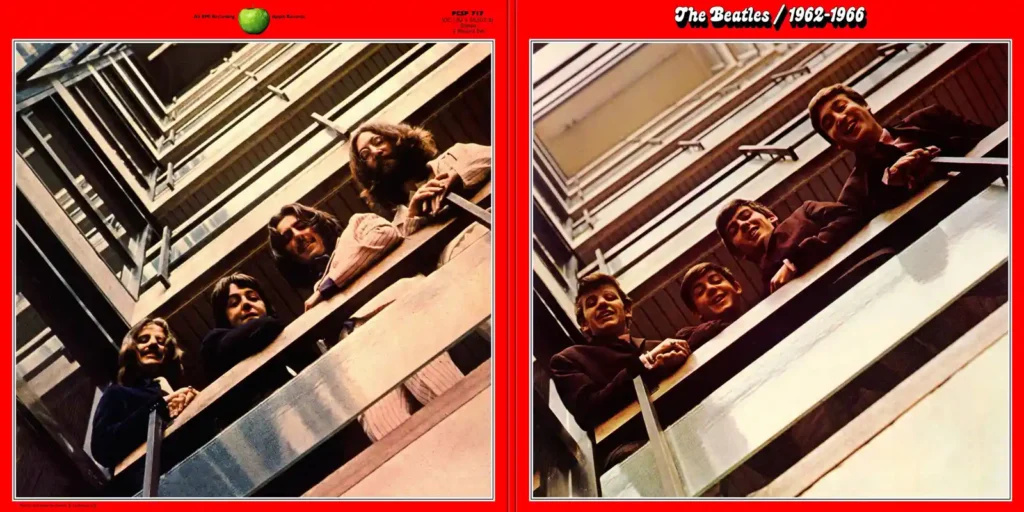
Sleeve artwork shown for the purpose of criticism and review under UK copyright fair dealing. Copyright remains with the respective rights holders. This use does not imply endorsement or affiliation.
Release, Charts, And Sales
The original Red Album peaked at Number 3 on the UK album chart and stayed in chart circulation for decades via reissues and catalogue sales. In the United States it also peaked at Number 3 on Billboard.
Commercially, it is one of the most successful greatest-hits albums ever released. In the US, it has been certified multi-platinum by the RIAA, reflecting enormous long-term sales rather than a short-lived chart spike.
Which Version Should You Get?
Pick based on how you actually listen:
- You want the classic experience: go with the original 26-track running order (1973 tracklist). It is brutally efficient and plays like a greatest-hits set built for vinyl sides.
- You want a fuller 1962–66 story with modern sound: the 2023 edition is the one. It fixes the biggest omissions (covers and Harrison) and upgrades most of the audio with new mixes.
- You collect vinyl: the 2023 3LP set keeps the 1973 running order on the first two discs and puts the extras on LP3, which is a sensible compromise between nostalgia and expansion.
- You stream or want chronological flow: the 2023 CD/digital sequencing is designed more like a timeline playlist than a 1973 double album.
BeatlesFan.Club operates independently and does not affiliate with The Beatles, Apple Corps, or any official rights holders.
Take A Listen
Listen to the album, then share your thoughts on the Beatles Fan Club Forum.
Prefer not to accept optional cookies? Open this album on Spotify.
Sources And References For The Beatles Red Album
- The Beatles – Original 1973 album overview.
- The Beatles – 2023 expansion and added tracks.
- Official Charts Company – UK chart history.
- RIAA – US certification record.
BeatlesFan.Club operates independently and does not affiliate with The Beatles, Apple Corps, or any official rights holders.
