
“This Boy” is the B-side to “I Want To Hold Your Hand”, released in the UK on 29 November 1963 at the point when Beatlemania was turning from a British phenomenon into an international one. In the US, however, the song took a different route: instead of appearing on the American single, it was placed on Meet The Beatles!, which meant many listeners first knew it as an album track rather than a flip side.
That matters because “This Boy” is far more than a secondary single track. It is one of the Beatles’ finest early harmony performances, one of John Lennon’s clearest attempts to write in a Smokey Robinson-inspired style, and a song with an unusually long afterlife for a 1963 B-side, later reappearing on Past Masters, Anthology 1, and On Air: Live At The BBC Volume 2. Its melody even returned in orchestral form as “Ringo’s Theme” in A Hard Day’s Night.
Key Facts
- Released: 29 November 1963 (UK single)
- US Release Route: Issued on Meet The Beatles! rather than as the American B-side to “I Want To Hold Your Hand”
- Recorded: 17 October 1963
- Mixed: 21 October 1963
- Studio: EMI Studios, London
- Format: 7-inch single B-side in the UK
- Genre: Beat / doo-wop / pop
- Track Duration: 2:13
- Record Label: Parlophone R 5084 (UK)
- Songwriters: Lennon-McCartney
- Producer: George Martin
- Engineer: Norman Smith
Performers And Instruments
- John Lennon: double-tracked lead vocal, acoustic guitar
- Paul McCartney: high harmony vocal, bass guitar
- George Harrison: middle harmony vocal, lead guitar
- Ringo Starr: drums
Where To Find “This Boy”
You can hear the song on the following official Beatles releases and related appearances:
- Original 7-inch single – B-side of “I Want To Hold Your Hand” (UK)
- Meet The Beatles! – the US album placement that introduced the song to many American listeners
- Past Masters – the standard official home for the original studio master on CD and later catalogue reissues
- Anthology 1 – live performance from The Morecambe And Wise Show
- On Air: Live At The BBC Volume 2 – BBC performance for Saturday Club, recorded 17 December 1963 and broadcast 21 December 1963
This Boy: Background
“This Boy” shows the Beatles moving away from straight rock ‘n’ roll. Instead, they built it around vocal blend and close harmony. John Lennon later described it as “just my attempt at writing one of those three-part harmony Smokey Robinson songs”. That comment is therefore the right starting point for understanding the song. The song does not aim for lyrical complexity. Its strength lies in tone, structure, and the way the three voices lock together.
That harmony writing is what makes the record stand out. Lennon takes the low line, McCartney soars above him, and Harrison fills the middle, creating a much tighter and more deliberate arrangement than the Beatles had used on most of their earlier singles. This was not just a case of three singers piling in around one melody. The parts were designed to interlock, and the finished record sounds far richer because of it.
The Smokey Robinson influence also matters because it shows Lennon writing against type. He is often remembered in the early period as the tougher rocker of the Lennon-McCartney pair, but “This Boy” is one of the songs he later pointed to as proof that he could write melody just as well as anyone. That gives the song real historical importance. More importantly, it marks an early point where Lennon pushed his writing beyond basic beat-group formulas.
This Boy Sleeve Review And Description
The black Parlophone label immediately gives it that classic early-sixties look, and the intact push-out centre adds to the period feel rather than making it look like a modern reproduction. What really lifts the image, though, is the original EMI company sleeve around it.
The green promotional text for Emitex cleaning material, record tokens and Record Mail turns the picture into more than just a label shot; it becomes a snapshot of how British records were packaged and sold in late 1963. The wear, creasing and slight discolouration are not drawbacks here. They make the image feel authentic and lived-in, which suits a page about “This Boy” because the song belongs to the exact moment when Beatlemania was breaking wide open. The wording on the label is also useful to collectors and serious fans, with “Recording first published 1963”, the Northern Songs credit, and the clear “Made in Gt. Britain” line all reinforcing that this is a genuine period UK single image rather than generic artwork.

Smokey Robinson Influence
Lennon was aiming directly at the sound of Smokey Robinson and the Miracles, especially the slow, circling feel of an R&B ballad rather than the crack of a Merseybeat stomp. You can hear that in the chord movement, the doo-wop shape of the verses, and the way the arrangement lets the harmonies carry the emotion.
The result is gentler than “She Loves You” or “I Want To Hold Your Hand”, but it is no weaker for that. It shows the Beatles already reaching well beyond the basic beat-group formula in late 1963.
There is also a strong contrast at the centre of the performance. The verses are smooth and disciplined, but the middle eight breaks that calm open. When Lennon hits “Oh, and this boy would be happy just to love you”, the song suddenly becomes more dramatic and more desperate. That emotional lift is one reason “This Boy” still feels stronger than many early Beatles B-sides.
This Boy: In The Recording Studio
The Beatles recorded “This Boy” on 17 October 1963 during the same session that produced “I Want To Hold Your Hand”. That alone makes the day important, because one session delivered both sides of a landmark single. After finishing the A-side, they turned to “This Boy” and worked through fifteen takes before the final overdubs and editing were completed.
The session is worth noting for another reason: the finished master was not simply one complete live performance. The Beatles joined parts of two takes together. They then added a fade during the 21 October mixing session even though the performance had a proper ending. Engineers used that kind of editing regularly by late 1963. Even so, this edit helped shape a very polished result from a song that still sounds emotionally raw in the middle section.
Musically, the record is deceptively simple. There is no flashy arrangement and no studio gimmick pulling attention away from the singing. Instead, the performance depends on control: Lennon’s double-tracked lead, the precise harmony stack, Harrison’s lead guitar support, McCartney’s steady bass, and Starr’s restrained drumming. That discipline is exactly why the middle eight lands so hard when Lennon suddenly pushes the vocal into a more anguished register.
This Boy In America And On Television
“This Boy” had an unusual release history outside Britain. In the US it was not the B-side of “I Want To Hold Your Hand”; Capitol used “I Saw Her Standing There” for that single instead and placed “This Boy” on Meet The Beatles!. That decision gave the song a second identity: British fans knew it as a flip side, while American listeners often met it as one of the early album tracks that helped launch the group in the States.
The song also moved quickly into the Beatles’ television repertoire. They performed it on their second Ed Sullivan Show appearance on 16 February 1964, which means it was heard by a huge American audience at the precise moment the group were becoming a national obsession there. That gives “This Boy” more historical weight than many B-sides can claim.
Ringo’s Theme And Later Variations
One of the most interesting facts about “This Boy” is that its melody did not stay confined to the original single. George Martin reworked the song into the orchestral cue “Ringo’s Theme (This Boy)” for A Hard Day’s Night. He then used the tune as incidental music for the film. That reworking gave the song a second life in instrumental form. It also linked it directly to one of the Beatles’ best-known films.
The song’s later archive history is also unusually rich. Anthology 1 includes the performance from The Morecambe And Wise Show. As a result, it shows how well the harmony arrangement worked outside the studio. On Air: Live At The BBC Volume 2 adds a BBC version from Saturday Club, recorded on 21 December 1963. Together, those releases make “This Boy” one of the better-documented early Beatles songs beyond its original single appearance.
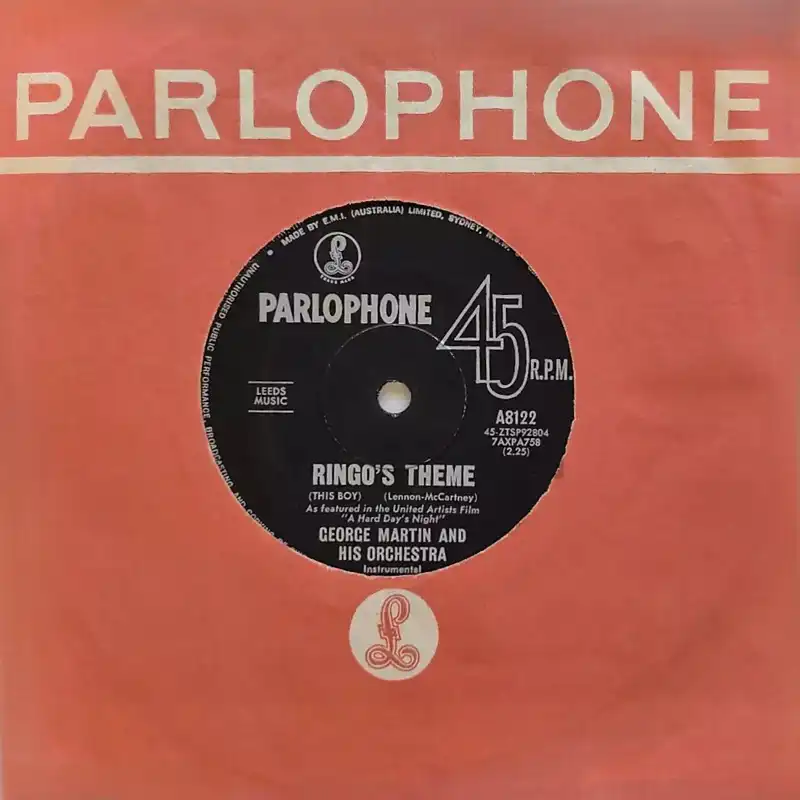
Ringo’s Theme Sleeve Review And Description
This image works well because it shows the afterlife of “This Boy” in a very different form. Visually, it looks cleaner and bolder than the Beatles single image. In particular, the large orange Parlophone sleeve creates a stronger block of colour and makes the black label stand out immediately. That contrast makes it a good companion image on the page. As a result, it balances the more cluttered and text-heavy EMI sleeve used for the Beatles disc.
The label itself is where the real interest lies: “Ringo’s Theme (This Boy)” is credited to George Martin And His Orchestra, and the wording ties it directly to A Hard Day’s Night, which helps explain to readers that this was not some unrelated cover version but an official orchestral adaptation built from the same melody. The Australian manufacturing line around the rim adds another collector angle, giving the image extra value for readers interested in international Beatles-related releases. Taken as a visual, it is not as evocative as the UK Beatles single, but that is exactly why it is useful. It shows how the melody moved from a close-harmony Lennon ballad into a film-linked instrumental product with its own separate identity in overseas markets.
Take A Listen
The official 2009 remaster is embedded below. Once you have given it another spin, carry the discussion over to the Beatles Fan Club Forum.
If you’d rather not load the YouTube player on this page, open the video directly on YouTube instead.
Sources And References
- The Beatles – Official release, recording, US album, Ed Sullivan and Past Masters details.
- The Beatles – Official On Air: Live At The BBC Volume 2 album page.
- The Beatles – Official soundtrack page listing “Ringo’s Theme (This Boy)”.
- The Beatles – Official Anthology 1 album page.
BeatlesFan.Club operates independently and does not affiliate with The Beatles, Apple Corps, or any official rights holders.
Images shown in this article are for identification, commentary, criticism and review in connection with The Beatles’ “This Boy” and George Martin’s “Ringo’s Theme (This Boy)”. They are included in low-resolution form for contextual discussion only and remain the property of their respective copyright and trade mark owners. Their use here is intended to rely on fair dealing under UK copyright law for criticism, review and/or quotation with acknowledgement, and not as a substitute for the original commercial images or records.
