

The Beatles’ third UK studio album, “A Hard Day’s Night” (1964), is the moment their songwriting fully takes over. It is the first Beatles LP made entirely of Lennon-McCartney originals, and it doubles as the soundtrack to their debut feature film (we review the film here). Use the player further down the page to explore the full track list.
A Hard Day’s Night Album: Key Facts
- Release date (UK): 10 July 1964
- Recorded: 29 January to 2 June 1964
- Record label: Parlophone
- Studios: EMI Studios (London), plus Pathé Marconi Studios (Paris)
- Genre: Merseybeat, pop, rock, pop rock
- Album duration: 30:09
- Producer: George Martin
- Engineer: Norman Smith
Performers And Instruments
- John Lennon: lead and harmony vocals, electric and acoustic guitars, harmonica, tambourine
- Paul McCartney: lead and harmony vocals, bass guitar, piano, occasional percussion
- George Harrison: electric and acoustic guitars (including 12-string), vocals, occasional percussion
- Ringo Starr: drums, conga, tambourine, cowbell, other percussion
- George Martin: production, and piano on select tracks
A Hard Day’s Night Album Tracks
The vocalists are in brackets:
Side One
- A Hard Day’s Night (Lennon with McCartney)
- I Should Have Known Better (Lennon)
- If I Fell (Lennon with McCartney)
- I’m Happy Just To Dance With You (Harrison)
- And I Love Her (McCartney)
- Tell Me Why (Lennon)
- Can’t Buy Me Love (McCartney)
Side Two
- Any Time At All (Lennon)
- I’ll Cry Instead (Lennon)
- Things We Said Today (McCartney)
- When I Get Home (Lennon)
- You Can’t Do That (Lennon)
- I’ll Be Back (Lennon with McCartney)
Why This Album Matters
“A Hard Day’s Night” is where The Beatles sound like a band with a clear direction. The pace is brisk, the hooks land instantly, and the writing is confident enough to carry a full LP without leaning on cover versions. It is also a rare Beatles album where the songwriting credit is consistent across the whole track list: every song is credited to Lennon-McCartney.
Soundtrack Side, Non-Soundtrack Side
One reason the album flows so well is its built-in structure. Side One matches the film’s on-screen performances, while Side Two works as a separate burst of new material that never appears in the movie. That split gives you the best of both worlds: the cinematic rush up front, then a tighter “studio album” feel as the record turns over.
Four-Track Recording And A Bigger Sound
EMI upgraded to four-track recording for this project, replacing the earlier two-track approach used on previous Beatles LPs. That extra flexibility helped the band and George Martin build stronger rhythm tracks, layer vocals more cleanly, and shape the punchy, forward mix that defines the album.
The Opening Chord And The 12-String Jangle
The famous opening hit of “A Hard Day’s Night” is not just a great start, it is a statement of intent: bright, dense, and instantly recognisable. Across the album, the chiming 12-string guitar sound (often associated with George Harrison) helps define the era and became a blueprint for countless guitar bands that followed.
Paris Session: A Useful Detail
Although most of the album was recorded in London, the sessions began in Paris on 29 January 1964. The group were there for concerts and used the trip to record “Can’t Buy Me Love”, which later became one of the record’s defining hits.
The same 29 January 1964 Paris session also produced the German-language remakes “Komm, gib mir deine Hand” and “Sie liebt dich“. That makes it the Beatles’ only recording session outside the UK, which gives the album’s opening recording date a bit more significance than it first appears.
Album Cover
The cover art looks like a film contact sheet: multiple frames, changing expressions, and a clean, modern layout that fits the movie tie-in without turning the album into a gimmick. It also bridges the visual jump from the moody half-lit “With The Beatles” sleeve to a more playful, screen-friendly look.
US Version
In the United States, the story is slightly different. Two weeks before the UK album, United Artists issued a soundtrack LP called “A Hard Day’s Night” that mixes Beatles songs with orchestral instrumentals from the film score. The UK running order later became the standard international version in the CD era, which is why American listeners often discovered the “proper” UK album line-up much later.

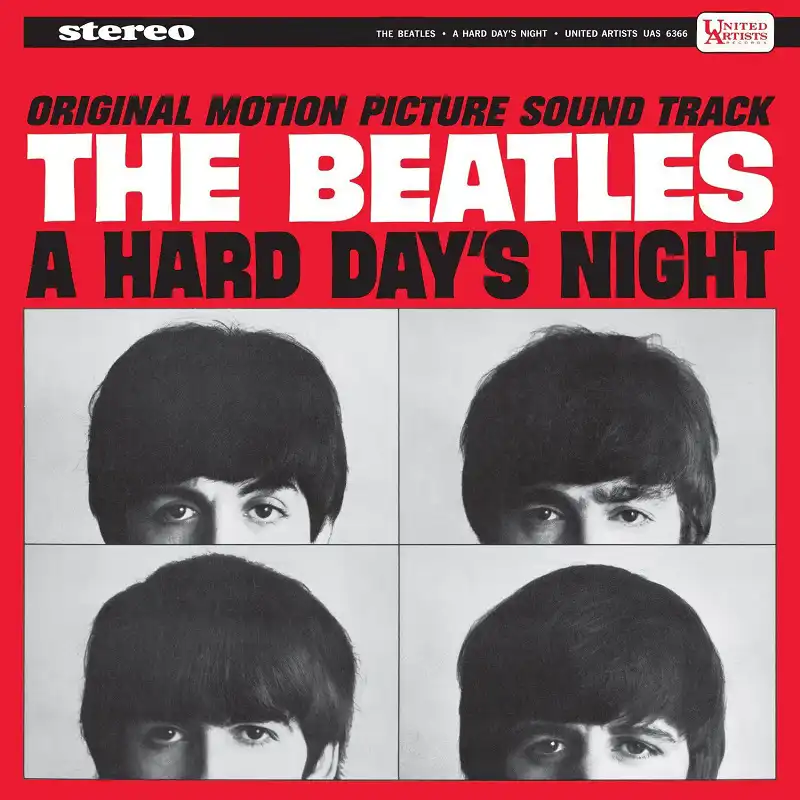
Fair Dealing Disclaimer: These low-resolution album cover images are used under fair dealing for review, criticism, and identification. Copyright remains with the rights holders.
A Hard Day’s Night Album: Chart Success
In the UK, “A Hard Day’s Night” replaced “With The Beatles” at number one and stayed there for 21 weeks. It also remained on the main album chart for 38 weeks in total.
Have Your Say
What is your standout moment on the album: the opening chord, the harmonies, or the sheer pace of the performances? Share your view in the Beatles Forum.
Take A Listen
Prefer not to accept optional cookies? Open this on Spotify.
Sources And References
- The Beatles – Official album page for A Hard Day’s Night (release details, track listing, credits).
- Official Charts Company – UK Albums Chart performance data.
- The Beatles – U.S. release context for the United Artists soundtrack and Something New.
- Wikipedia – Recording dates, Paris session, and cover overview.
BeatlesFan.Club operates independently and does not affiliate with The Beatles, Apple Corps, or any official rights holders.
