
“She Loves You” is one of the defining Beatles records and one of the clearest turning points in the whole story of Beatlemania. Released as a single in August 1963, it turned the group’s rising success into national hysteria in Britain and then helped carry that momentum into the United States the following year.
It also deserves more than the usual “yeah yeah yeah” summary. “She Loves You” remains the Beatles’ best-selling single in the UK, it was the biggest-selling British single of the 1960s, and its history includes several details that still matter today: a writing session that ran from a tour bus to a hotel room to 20 Forthlin Road, a lost session tape that left the hit officially mono for decades, and a later German remake titled “Sie Liebt Dich”.
Key Facts
- Release Date: 23 August 1963 (UK), 16 September 1963 (US)
- Format: 7-inch single (A-side), with “I’ll Get You” as the B-side
- Recorded: 1 July 1963
- Studio: EMI Studios, London
- Genre: Pop rock
- Track Duration: 2:18
- Label: Parlophone R 5055 (UK), Capitol 72125 (Canada), Swan 4152 (US)
- Songwriter: Lennon-McCartney
- Producer: George Martin
- Engineer: Norman Smith
- UK Sales Milestone: Officially the biggest-selling single of the 1960s in the UK
Performers And Instruments
- John Lennon – lead and backing vocals, rhythm guitar
- Paul McCartney – lead and backing vocals, bass guitar
- George Harrison – backing vocals, lead guitar
- Ringo Starr – drums
Where To Find “She Loves You”
- Original 7-inch single
- Past Masters
- 1 Album
- The Beatles’ Second Album / The Beatles: 1964 U.S. Albums In Mono (2024 vinyl reissue)
- The Beatles 1962-1966 (2023 Edition) – 2023 mix
- Anthology 1 / The Beatles Anthology Collection (2025 Edition) – live Royal Variety Performance version
- On Air: Live At The BBC Volume 2 – BBC version
The original hit recording is on the 1963 single, Past Masters, 1, and the expanded 1962-1966 collection. Anthology 1 and On Air do not contain the original studio master; they contain later live and BBC performances instead.
How “She Loves You” Was Written
Lennon and McCartney began writing “She Loves You” on 26 June 1963 after a show at the Majestic Ballroom in Newcastle upon Tyne while touring with Roy Orbison and Gerry and the Pacemakers. They started it on the tour bus, continued in their hotel that night, and finished it the next day at Forthlin Road.
McCartney later said the first spark came from Bobby Rydell’s hit “Forget Him”. He originally imagined “She Loves You” as a call-and-response song, with one voice singing the title and the others answering “yeah, yeah”, before Lennon and McCartney reshaped the idea into the finished chorus. That matters because it shows the song did not just appear fully formed on the Newcastle tour; it grew out of a specific pop-writing problem they solved unusually well.
That origin matters because it shows how quickly the early Lennon-McCartney partnership could move. The song was not the product of weeks of polishing; it was caught in the rush of touring, then sharpened at home into something immediate and commercial. Even so, it already showed a real shift in their writing.
McCartney later explained that one of the clever shifts in “She Loves You” was the third-person angle. Instead of singing directly from “I” to “you”, the narrator delivers a message from someone else. That small change moved the lyric away from the most obvious early-love-song pattern and gave the chorus more urgency.
That third-person angle is one of the best things to highlight on the page. “She Loves You” is not just another early Beatles love song. The singer is not pleading for love himself; he is delivering news. That small change gave the lyric more movement and made the chorus land harder.
At 20 Forthlin Road
Like many important early Beatles songs, this one was finished at Paul McCartney’s family home. The famous final argument was not between Lennon and McCartney, but between the writers and Paul’s father Jim.
McCartney later recalled playing the song to his father Jim, who liked it but wondered whether “yes, yes, yes” would be better than the American-sounding “yeah, yeah, yeah”. Lennon and McCartney instantly knew that would kill the record’s punch. The modern snap of “yeah” was part of the point.
That story survives because it captures exactly what was changing in British pop in 1963. Jim McCartney heard a catchy song. Lennon and McCartney heard a modern record. The difference between “yes” and “yeah” looks tiny on paper, but it was part of what made the song feel young, punchy, and new.
Why The Song Hit So Hard
“She Loves You” does not waste time. Instead of easing in with a verse, the Beatles hit the hook almost immediately. The “yeah, yeah, yeah” refrain arrives at once, which is one reason the record still feels explosive. It gets to the point before most pop singles of the day had even settled into their first line.
There is another strong musical detail many lighter pages ignore: the ending. George Martin was struck by the unusual final major sixth chord, which the Beatles loved and insisted on keeping. It helped give the record a more dramatic, slightly unexpected finish than a routine pop cadence would have done.
The whole arrangement is part of the effect. The bass is pushed hard, the drums punch through, and Lennon and McCartney switch between unison and harmony in a way that makes the record sound fuller than most British singles of 1963. That is one reason the song still sounds like a breakthrough rather than just an early hit.
Recording And Why The Original Was Mono Only
The Beatles recorded both “She Loves You” and its B-side on 1 July 1963 at EMI Studios in London. Documentation for the session no longer survives, so the exact number of takes is unknown. What is known is that the song was recorded on twin-track and then mixed down in the standard way used for singles at the time.
That routine decision had a huge long-term consequence. After the mono master was made, EMI erased the original twin-track tape. The same fate also hit “Love Me Do“, “P.S. I Love You“, and “I’ll Get You”. For decades, that meant there was no true original stereo mix to issue, only the mono hit and later fake-stereo attempts.
This is one of the most important technical facts on the page because it shaped how generations of listeners heard the song. For a long time, the answer to “Why is She Loves You only in mono?” was simple: because the source tape was gone.
The 2023 Mix
That old mono-only story changed in 2023. “She Loves You” was included as a “2023 Mix” on the expanded The Beatles 1962-1966 collection, where the updated edition presented the Red Album in stereo and Dolby Atmos. After decades in which the hit was tied almost entirely to mono releases, the song finally received a new official mix for the modern catalogue.
This is the proper way to update the page now. There is no need for a dated correction box anymore. The cleaner approach is simply to explain the history clearly: the original session tape was destroyed after the mono mix, which limited official options for years, but a new official 2023 mix now exists on the expanded Red Album.
Chart Success And Beatlemania
“She Loves You” was the record that took the Beatles from strong chart act to full social phenomenon in Britain. It became their best-selling UK single and is still officially the biggest-selling single of the 1960s in the UK, with 1.93 million sales recorded by Official Charts.
Its impact did not stop there. In the United States, the single later became part of the extraordinary Beatles domination of the charts in 1964, when five Beatles songs occupied the US Top Five at the same time. That alone is enough to show why this song belongs in any serious account of the band’s rise.
The song also left a broader cultural mark. The “yeah, yeah, yeah” refrain became so closely associated with the Beatles that in parts of Europe the group were nicknamed “the Yeah-Yeahs”. That hook was not just catchy; it became part of the band’s international identity.
She Loves You – Disc And Sleeve Review
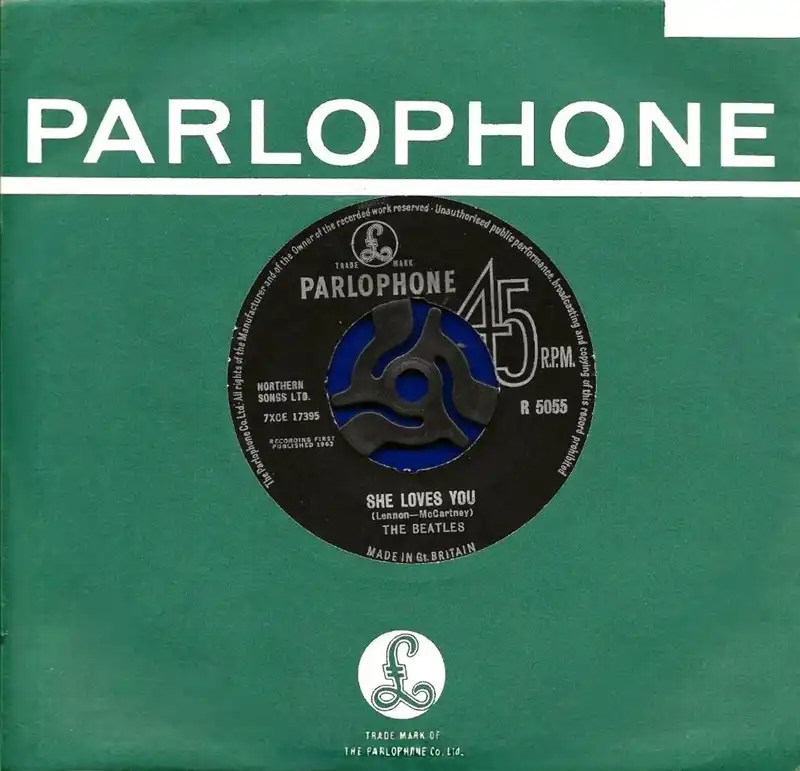
The green Parlophone company sleeve gives the single a clean, unmistakably British early-1960s look, with the bold white branding doing most of the visual work.
In the centre, the black Parlophone label and push-out insert make the disc itself the real focus rather than any picture-art gimmick.
That suits “She Loves You” perfectly: the presentation is plain, functional, and confident, just before Beatles packaging became a phenomenon in its own right.
As a piece of design, it is not flashy, but that restraint now feels part of its charm. It looks exactly like what it is – a hit record from the moment before Beatlemania packaging fully exploded.
Fair Dealing Disclaimer: This image is shown at reduced size for identification, criticism, and review of The Beatles’ 1963 single “She Loves You” under UK fair dealing for criticism and review. Copyright in the sleeve, label, and related artwork remains with the relevant rights holders, and this use supports commentary on the record’s original presentation.
German Version And Later Life
The Beatles re-recorded the song in German in 1964 as “Sie Liebt Dich”. That alone tells you how central the song had become so quickly. It was no longer just a British hit single; it was one of the songs the group considered important enough to adapt for another market.
The original English recording also had a long afterlife. It appeared on key compilation releases, stayed central to the Beatles’ public image, and even turned up in the fade of “All You Need Is Love” in 1967. By then, the song already belonged to Beatles history as well as Beatles present.
Why “She Loves You” Still Matters
There are bigger Beatles songs in some territories and more ambitious Beatles songs later on, but few records capture the exact moment the group turned into a mass phenomenon as clearly as this one. “She Loves You” is where the writing sharpened, the performance toughened up, the hook became unavoidable, and the public response exploded.
That is why the song still deserves careful treatment. It is not just famous because everyone knows it. It is famous because it changed what the Beatles were and helped change what pop singles could do.
Take A Listen
Give it another listen as more than just a familiar old hit. Listen for how quickly it starts, how hard the chorus lands, and how much force the Beatles squeeze into barely two minutes. Then share your thoughts in the Beatles Fan Club Forum.
If you’d rather not load the YouTube player on this page, open the video directly on YouTube instead. Open “She Loves You” on YouTube.
Sources And References
- The Beatles – Official “She Loves You” song page.
- Official Charts – UK sales and 1960s ranking.
- The Beatles – Official 2023 Red Album listing.
- The Beatles – Official 2025 Anthology listing.
BeatlesFan.Club operates independently and does not affiliate with The Beatles, Apple Corps, or any official rights holders.
