

“Love Me Do” is The Beatles’ debut single: the first record released under the band name, and the moment their recording career properly began. It came out in the UK on 5 October 1962 with “P.S. I Love You” on the B-side, then broke through internationally as Beatlemania exploded, including a US No. 1 in 1964.
It is also one of the most unusually documented early Beatles tracks because three different studio versions exist, each with a different drummer. That quirk is not trivia for collectors only: it changes what you actually hear on major releases, and it explains why “Love Me Do” can sound subtly different depending on which album you play.
Key Facts
- Release Date: 5 October 1962 (UK); 27 April 1964 (US)
- Format: 7-inch single (A-side) (B-side: “P.S. I Love You”)
- Recorded: 6 June 1962 (Pete Best version); 4 September 1962 (Ringo Starr version); 11 September 1962 (Andy White version)
- Studio: EMI Studios (Abbey Road), London
- Genre: Merseybeat, pop, R&B, rock and roll
- Track Duration: 2:22
- Record Label: Parlophone (UK); Tollie (US)
- Songwriters: Lennon-McCartney
- Producer: George Martin
- Engineer: Norman Smith
Performers And Instruments
4 September 1962 version (Ringo on drums) – used on the original UK single first pressing and later on Past Masters
- Paul McCartney: lead vocal, bass
- John Lennon: vocal, harmonica
- George Harrison: acoustic guitar
- Ringo Starr: drums
11 September 1962 version (Andy White on drums, Ringo on tambourine) – used on Please Please Me and the 1964 US single
- Paul McCartney: lead vocal, bass
- John Lennon: vocal, harmonica
- George Harrison: acoustic guitar
- Ringo Starr: tambourine
- Andy White: drums
6 June 1962 version (Pete Best on drums) – released on Anthology 1
- Paul McCartney: vocal, bass
- John Lennon: vocal, harmonica
- George Harrison: acoustic guitar
- Pete Best: drums
Where To Find “Love Me Do”
- Original UK 7-inch single – Ringo Starr version
- Please Please Me Album – Andy White version
- The Beatles’ Hits (EP) – Andy White version
- Past Masters – Ringo Starr version
- Live At The BBC – BBC performance
- Anthology 1 – Pete Best version
- 1 Album – single hit version
Love Me Do: Song Background
“Love Me Do” began as one of Paul McCartney’s earliest songs, written while the band were still learning how to move from covers to originals. Lennon later described it as “Paul’s song” from their teenage years, and McCartney has also described it as a true co-write from their formative period.
“Love Me Do is Paul’s song. He wrote it when he was a teenager. Let me think. I might have helped on the middle eight, but I couldn’t swear to it. I do know he had the song around in Hamburg, even way, way before we were songwriters.”
John Lennon, All We Are Saying – David Sheff
“Love Me Do was completely co-written… Love Me Do was our first hit, which ironically is one of the two songs that we control, because when we first signed to EMI, they had a publishing company called Ardmore and Beechwood that took the two songs, Love Me Do and PS I Love You, and in doing a deal somewhere along the way, we were able to get them back.”
Paul McCartney – Many Years From Now, Barry Miles
Why The Harmonica Matters
The song begins with Lennon on harmonica and keeps returning to that hook throughout, which made it instantly identifiable on radio and on stage.
The Beatles Anthology notes that the harmonica approach owed a lot to Bruce Channel’s hit “Hey! Baby”, and the arrangement created a practical problem: once Lennon had an instrument in his mouth, someone else had to take a key vocal line. The solution was simple, but you can hear how early this still was for them. It is the sound of a band learning in public.
Three Studio Versions And How To Spot Them
The song exists in three official studio recordings from 1962, each linked to the drummer situation as the band moved from Pete Best to Ringo Starr and, briefly, to a session player. That is why this single has more than one “standard” version in circulation.
- 6 June 1962 (Pete Best): Recorded at the group’s first EMI test session and later released on Anthology 1.
- 4 September 1962 (Ringo Starr): Re-recorded after Ringo joined; this version has no tambourine and became the original UK single first pressing.
- 11 September 1962 (Andy White): A further attempt with session drummer Andy White and Ringo on tambourine; this is the version used on Please Please Me Album and the 1964 US single release.
For catalogue use, this distinction matters: Past Masters restores the Ringo Starr single version, while Please Please Me uses the Andy White version. That is the quickest way to avoid confusing the debut single recording with the album master.
If you only remember one listening tip, make it this: tambourine = Andy White version. No tambourine usually means you are hearing the Ringo-on-drums take.
BBC Recordings
Once the single was out, The Beatles recorded “Love Me Do” repeatedly for BBC radio as part of their early national exposure. The commercially released BBC version appears on Live At The BBC and comes from a Pop Go The Beatles performance recorded on 10 July 1963 and broadcast on 23 July 1963.
Chart Success And Why It Is A Milestone
In the UK, the original 1962 single peaked at No. 17. Even so, it proved the band could sell records, not just fill clubs. After Beatlemania took hold, the song became a far bigger hit internationally, including a US No. 1 in 1964 – which is why it qualifies for 1 Album even though it never topped the UK chart.
The story also has a late twist: in 1982, EMI re-promoted the original UK single (without changing the catalogue number) and it reached No. 4, underlining how far the Beatles catalogue could still move decades after release.
Although The Beatles released “My Bonnie” earlier, that record was credited to Tony Sheridan with The Beatles as the backing band (and Pete Best on drums). “Love Me Do” is the first single that belongs to the Beatles story in the conventional sense. It put their name on the label, launched their songwriting, and kicked off their recording career.
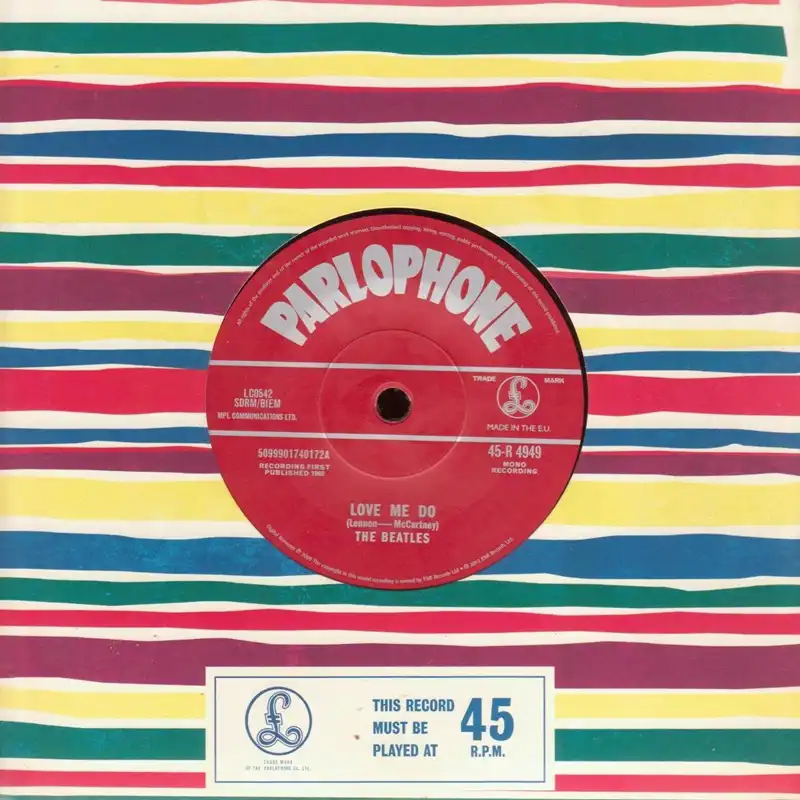
Image Description: A reissue-style sleeve design with horizontal multicolour stripes, a centred red Parlophone record label reading “LOVE ME DO” and “THE BEATLES”, and a boxed instruction at the bottom stating the record must be played at 45 R.P.M.
Fair Dealing Image Notice: This image is shown in reduced form for identification, commentary and review under UK fair dealing. Copyright remains with the respective rights holders. No endorsement or affiliation is implied. The image is not a substitute for the original artwork and will be removed or replaced on request from the copyright owner.
Take A Listen To “Love Me Do”
Listen carefully for which version you are hearing, then post your take in the Beatles Fan Club Forum: do you prefer the Ringo-on-drums single take, or the Andy White version with tambourine?
Prefer not to accept optional cookies? Open this video on YouTube.
Sources And References
- The Beatles – Official release, recording, label, and chart notes.
- The Beatles Anthology – Three 1962 versions and harmonica context.
- Official Charts – Original UK chart peak and chart run.
- Official Charts – 1982 UK re-promotion chart peak.
BeatlesFan.Club operates independently and does not affiliate with The Beatles, Apple Corps, or any official rights holders.
