
“I Feel Fine” is The Beatles’ 1964 single written primarily by John Lennon and backed with “She’s A Woman”. It introduced a punchy, riff-led sound and one of the earliest deliberate uses of guitar feedback on a major pop release.
Released in late November 1964 in the US and UK, it became The Beatles’ eighth British single and a major chart-topper, while the B-side also became a hit in its own right in North America.
Key Facts
- US Release: 23 November 1964
- UK Release: 27 November 1964
- Format: 7-inch single (A-side) (B-side is “She’s A Woman”)
- Recorded: 18 October 1964
- Studio: EMI Studios, London (Studio Two)
- Genre: Rock, rhythm and blues
- Track Duration: 2:25
- Record Label: Parlophone R5200 (UK), Capitol 5327 (US)
- Songwriters: Lennon-McCartney
- Producer: George Martin
- Engineer: Norman Smith
Performers And Instruments
- John Lennon: double-tracked lead vocal, guitar
- Paul McCartney: harmony vocal, bass guitar
- George Harrison: harmony vocal, lead guitar
- Ringo Starr: drums
Where To Find “I Feel Fine”
For the original studio master, start here:
- 7-inch single (A-side) (B-side is “She’s A Woman“)
- Past Masters
- 1 Album
For alternate performances and broadcast versions, these releases matter:
- Live At The BBC (Album) (BBC performance)
- On Air: Live at the BBC, Volume 2 (BBC outtake)
- Anthology 2 (live TV performance)
Background And Songwriting
Lennon wrote “I Feel Fine” during the period when the band were recording Beatles For Sale, but they kept it back as a standalone single rather than placing it on the UK album. By late 1964, that single strategy was deliberate: The Beatles used non-album A-sides to keep the catalogue lean while still delivering new hit records at speed.
The core is the riff. Lennon built it around a favourite groove and shaped it into an instantly recognisable hook, with Ringo Starr driving the track using a tight, R&B-flavoured feel that keeps the verses clipped and propulsive.
The Riff And Its Influences
“I Feel Fine” is a riff-driven single in the most literal sense: the guitar figure is the identity of the record, not just an introduction. Writers have long noted the connection to Bobby Parker’s 1961 song “Watch Your Step”, and the resemblance is part of what makes this track such a useful bridge between early 1960s R&B riffs and the heavier, hook-first rock writing that The Beatles pushed further with later singles.
Opening Feedback
The record begins with a single burst of feedback that functions like a percussive “hit” before the riff drops. The Beatles’ official site says Lennon planned it by having McCartney play a single note while the amplifier picked up feedback from Lennon’s guitar.
Later recollections sometimes describe it as a happy accident. Either way, what matters is the decision: they kept it, put it right at the front, and turned a studio sound into a hook that listeners could not miss.
Recording Session
The Beatles recorded “I Feel Fine” at EMI Studios on Sunday 18 October 1964 during a marathon session that ran from 2.30 pm to 11.30 pm. They worked on eight songs that day, and the other seven all fed into Beatles For Sale, which shows how tightly the single sat inside the same late-1964 creative rush.
Mixes, US Reverb, And Why Some Copies Sound Different
If you have ever compared pressings and wondered why the track sometimes sounds wetter or more distant, you are not imagining it. US releases and later reissues can differ in reverb and fade details, and some early US configurations pushed the ambience harder than UK listeners heard at the time.
I Feel Fine: Chart Success
“I Feel Fine” hit No. 1 in the UK and stayed there for five weeks through the Christmas period, reinforcing the band’s run of era-defining singles. In the United States it also reached No. 1, continuing their extraordinary streak of chart-toppers during 1964.
In Britain, it also made The Beatles the first act to score two consecutive UK Christmas No. 1 singles, following “I Want To Hold Your Hand” the previous year.
UK Parlophone Sleeve And Label Review
This is the classic UK Parlophone company sleeve (green) with a black Parlophone 45 label in the centre.
The label clearly shows the large “45 RPM” marking and the UK catalogue number “R 5200”, plus the familiar wording “SOLD IN U.K. SUBJECT TO RESALE PRICE CONDITIONS”. You can also see “Northern Songs” on the left (publisher credit), and “RECORDING FIRST PUBLISHED 1964”, which fits the period.
As a display piece, it works because it is instantly recognisable: bold PARLOPHONE branding, clean contrast, and a label layout that screams mid-60s UK pressing.
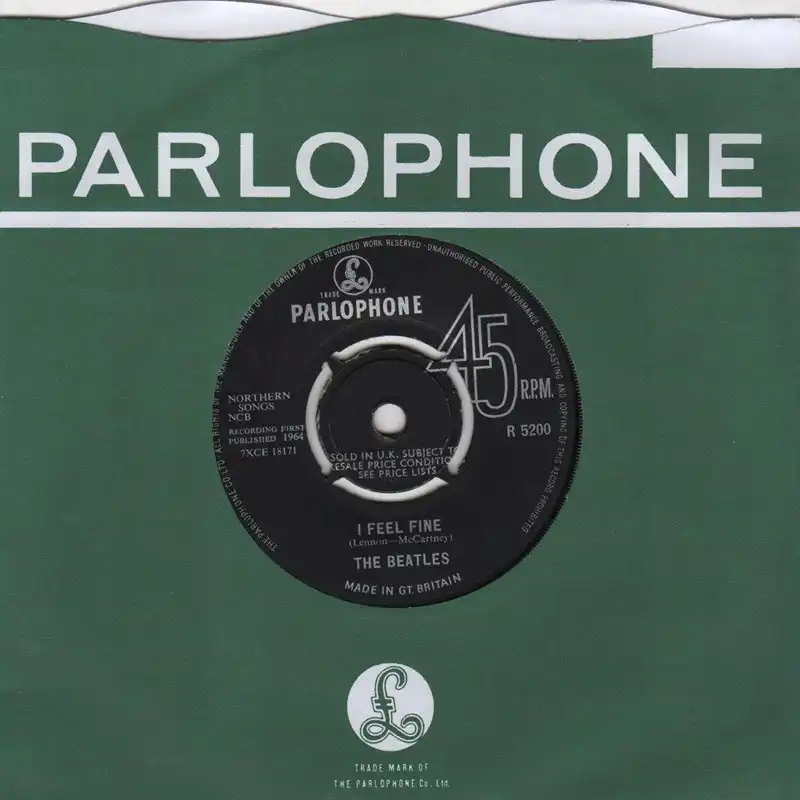
The downside (if you are reviewing it honestly) is that this is a generic company sleeve rather than a unique picture sleeve, so the visual “wow” comes from the label and branding rather than artwork.
Also, a photo alone cannot prove pressing authenticity or exact variant, but the visible details are consistent with a UK Parlophone release of “I Feel Fine”.
UK Fair Dealing Disclaimer (Criticism And Review): This image appears here for the purpose of criticism, review, and identification under UK fair dealing. Copyright and trademark rights remain with their respective owners. No ownership is claimed, and the image is shown at a limited size/context relevant to commentary. If you are a rights holder and believe this use is not appropriate, contact us and we will act promptly.
Promotional Films And Later Appearances
The Beatles filmed promotional clips for “I Feel Fine” in November 1965 as part of the shift away from constant in-person TV appearances. That move mattered: promos let them support releases internationally without travelling endlessly, and it became standard practice for major acts by the end of the decade.
The song also stayed in their live set into the mid-1960s and became one of the singles associated with the touring-era Beatles sound.
Take A Listen
Share your thoughts about “I Feel Fine” in the Beatles Fan Club Forum.
Prefer not to accept optional cookies? Open this video on YouTube.
Sources And References For I Feel Fine
- The Beatles – Official song page and single data
- The Beatles – Background notes and promo context
- Official Charts Company – UK No. 1 run and Christmas chart record
- Billboard – US Hot 100 No. 1 chart
BeatlesFan.Club operates independently and does not affiliate with The Beatles, Apple Corps, or any official rights holders.
