
The Beatles Reel Music Album matters because it shows how the Beatles catalogue was being repackaged around film nostalgia in the early 1980s. Released in 1982, the album gathered 14 songs connected with the band’s screen work, from A Hard Day’s Night and Help! through Magical Mystery Tour, Yellow Submarine, and Let It Be.
That makes Reel Music a useful but awkward Beatles compilation. It is not a soundtrack album, not a proper film anthology, and not the best modern way to hear these songs. Its value lies in what it reveals about the post-breakup catalogue era, when Capitol and Parlophone could turn familiar Beatles recordings into a movie-themed product with new artwork, packaging, and a promotional single.
The Beatles Reel Music Album: Key Facts
- Artist: The Beatles
- Album Type: Compilation album
- US Release: March 1982
- UK Release Date: 29 March 1982
- UK Label: Parlophone
- UK Catalogue Number: PCS 7218
- US Label: Capitol Records
- US Catalogue Number: SV 12199
- Track Count: 14 tracks
- Main Theme: Songs associated with Beatles films
- Promotional Single: “The Beatles Movie Medley”
- Why It Matters: A post-breakup compilation that repackaged Beatles film music for the early-1980s nostalgia market
What The Reel Music Album Actually Is
Reel Music is a compilation album, not a new Beatles project. Every song had already been released before 1982. The album’s point was not new music, but a new theme: collect Beatles songs linked to the group’s film career and sell them as a cinema-flavoured package.
That sounds simple, but the execution is messier than the idea. Reel Music does not include every important Beatles film song, and it does not work like a complete soundtrack collection. It is a selection. The album moves across five screen projects: A Hard Day’s Night, Help!, Magical Mystery Tour, Yellow Submarine, and Let It Be.
That gives the album a real subject, but not a perfect structure. It is best understood as a themed catalogue product from 1982, not as a definitive guide to The Beatles on film.
Why Reel Music Appeared In 1982
The timing matters. By 1982, the Beatles catalogue had already been repackaged several times after the band’s split. The Red and Blue albums had summarised the main story. Rock ‘n’ Roll Music had sold the group as rockers. Love Songs had sold them as romantic writers. The Beatles Ballads had pushed the softer side of the catalogue. Reel Music continued that pattern by giving the catalogue a film angle.
The album also appeared close to renewed interest in A Hard Day’s Night, which was returning to cinemas in cleaned-up form. That made a Beatles film-song compilation commercially logical. The record companies were not only selling music. They were selling memory: cinema queues, television screenings, film posters, and the image of The Beatles as screen personalities.
That is why Reel Music belongs with the early-1980s catalogue releases rather than with the band’s original 1960s albums. It tells us less about what The Beatles chose to make and more about how their work was being repackaged after they were gone.
Reel Music Track Listing
Side One
- “A Hard Day’s Night“
- “I Should Have Known Better“
- “Can’t Buy Me Love“
- “And I Love Her“
- “Help!“
- “You’ve Got To Hide Your Love Away“
- “Ticket To Ride“
- “Magical Mystery Tour“
Side Two
- “I Am The Walrus“
- “Yellow Submarine“
- “All You Need Is Love“
- “Let It Be“
- “Get Back“
- “The Long And Winding Road“
The track list is strong at first glance because it contains famous songs from several Beatles film projects. But it is not a complete film-song collection. It leaves out important screen songs such as “If I Fell“, “I’m Happy Just To Dance With You“, “You’re Going To Lose That Girl“, “Another Girl“, “The Fool On The Hill“, “Your Mother Should Know“, and other material that could have fitted the concept.
What The Album Gets Right
The strongest thing about Reel Music is that it reminds listeners how central film was to the Beatles story. The Beatles were not only a recording group. Their rise was tied to cinema, television, image, humour, and movement. The songs on this album carry that screen history with them.
The first side is especially effective. It moves from A Hard Day’s Night through Help! and into Magical Mystery Tour, showing how quickly The Beatles changed on screen between 1964 and 1967. The early black-and-white freshness of “A Hard Day’s Night” and “I Should Have Known Better” sits beside the more reflective “You’ve Got To Hide Your Love Away” and the colourful self-mythology of “Magical Mystery Tour”.
The second side is more uneven, but it has heavyweight material: “I Am The Walrus”, “All You Need Is Love”, “Let It Be”, “Get Back”, and “The Long And Winding Road”. Even as a clumsy compilation, the album still reminds readers that Beatles film music was not just background. It included major singles, album landmarks, and some of the most recognisable songs in the catalogue.
Where The Album Gets Messy
The weakness is that the concept is too loose. Reel Music is not a soundtrack album because it combines songs from several different films. It is not a complete film anthology because it leaves out too much. It is not a hits album because the organising principle is screen use rather than chart success.
That leaves the album caught between categories. It has a strong idea, but not a fully satisfying execution. A more serious Beatles film compilation would have needed either a broader track list, a double-album format, or clearer notes explaining exactly why these songs were chosen.
That does not make the album useless. It makes it very 1982. It belongs to a period when Beatles compilations were often built around marketable themes rather than careful archival logic.
The Film Projects Behind The Album
Reel Music pulls from five Beatles screen projects, and each one represents a different stage in the band’s career. A Hard Day’s Night shows The Beatles as quick, witty, black-and-white pop modernists. Help! turns them into broader comic film stars. Magical Mystery Tour captures their self-directed psychedelic television experiment. Yellow Submarine expands the group into animation and fantasy. Let It Be documents the final public phase of the band.
That spread is what makes the album more interesting than a routine compilation. Heard in order, the tracks do not simply play as songs. They also suggest a visual journey from Beatlemania to late-period documentary realism.
That is also why the album deserves a page separate from the individual film pages. Reel Music is not about one film. It is about the record company turning the entire screen side of The Beatles into a single retail object.
The Beatles Movie Medley
The album’s strangest companion was “The Beatles Movie Medley”, a 1982 single edited from snippets of Beatles film songs. It was not included on the album itself, but it was issued to promote the film-themed package.
The medley used excerpts from “Magical Mystery Tour”, “All You Need Is Love”, “You’ve Got To Hide Your Love Away”, “I Should Have Known Better”, “A Hard Day’s Night”, “Ticket To Ride”, and “Get Back”. That made it a crude but commercially effective sampler of the same broad idea behind Reel Music.
The single now feels like one of the more awkward Beatles releases. It belongs to the early-1980s medley craze more than to the group’s artistic legacy. But historically it matters because it shows how aggressively the catalogue could be reshaped for current trends, even when the result sat uneasily with the band’s reputation.
In Britain, “The Beatles Movie Medley” reached No. 10 on the Official Singles Chart. That is the uncomfortable proof that even a stitched-together Beatles medley could still become a Top 10 record in 1982.
The Packaging And Booklet
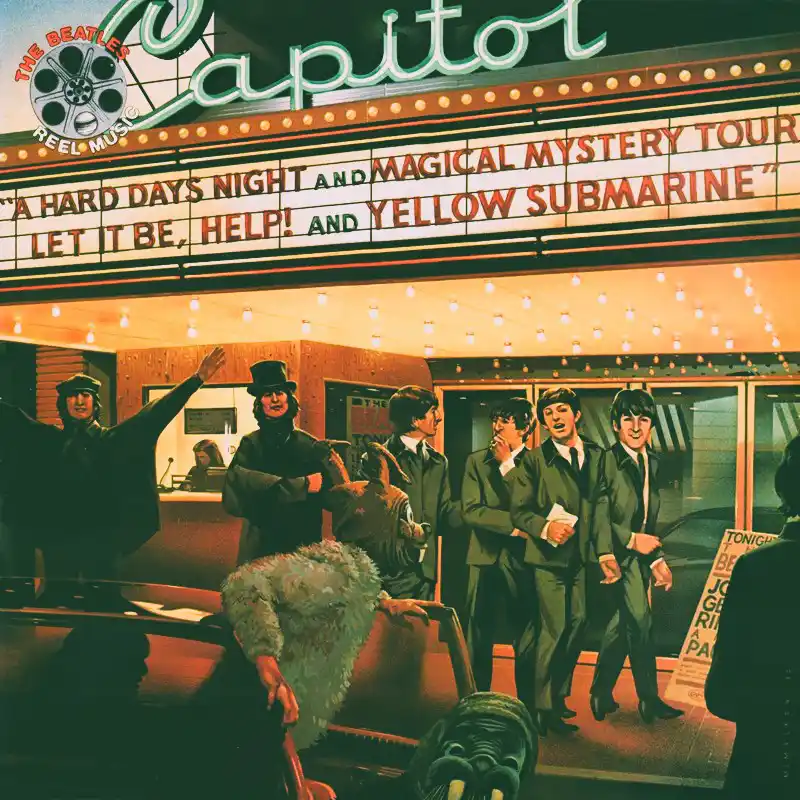
The packaging is one of the main reasons Reel Music still stands out. The sleeve uses cinema imagery, with a theatre marquee, film-reel branding, illustrated Beatles figures, and references to the band’s films. It sells the album visually before the track list even begins.
The album also came with film-themed presentation material, including a booklet and inner-sleeve imagery in several editions. That matters because it shows the package was not just a random budget compilation. It was designed as a Beatles film object, even if the music selection was incomplete.
That is why the cover deserves proper discussion. It may not be subtle, but it is highly specific. Unlike a plain greatest-hits sleeve, it tells the buyer exactly what fantasy is being sold: The Beatles under cinema lights.
The Reel Music cover uses cinema-marquee imagery, film-reel branding, and illustrated Beatles figures to present the album as a movie-themed catalogue release. Its value here is historical as well as visual, because the artwork shows how Capitol and Parlophone repackaged The Beatles in 1982 around their screen career rather than their studio-album development.
Fair Dealing Disclaimer: This low-resolution album cover image is used for identification, review, and historical commentary. Artwork and design remain the property of their respective rights holders.
The Sound And Mix Details
Reel Music also has collector interest because of some of the mixes and edits used on particular versions. The American release is especially discussed by collectors because it included several stereo presentations that were unusual in the US market at the time, including a distinctive edit of “I Should Have Known Better”.
That kind of detail is not the main reason a casual listener would seek out the album, but it is part of the reason collectors still pay attention to it. Post-breakup Beatles compilations were often more complicated than they looked. Different territories, tape choices, stereo versions, and edits could make a supposedly simple compilation more interesting than its title suggested.
Even so, the album should not be oversold as an audio essential. Its value is mainly historical and discographical. For normal listening, the songs are now better heard through the standard Beatles albums and current official catalogue releases.
Why Reel Music Is Not A Proper Soundtrack Album
One common mistake is to treat Reel Music as a Beatles soundtrack album. It is not. The Beatles already had individual film-related albums and releases: A Hard Day’s Night, Help!, Magical Mystery Tour, Yellow Submarine, and Let It Be all have their own histories.
Reel Music is a later compilation built from that screen history. It removes songs from their original film and album contexts and turns them into a single cinema-themed playlist.
That distinction matters. The album is useful for understanding how The Beatles were marketed in 1982, but it is not the best way to understand any one film. Readers should use the individual film pages for that. Reel Music belongs to the catalogue-repackaging story.
How Reel Music Fits The Post-Breakup Catalogue
Reel Music sits in the same broad family as Rock ‘n’ Roll Music, Love Songs, Rarities, and The Beatles Ballads. These albums were not created by The Beatles as artistic statements. They were record-company compilations built around themes, gaps, moods, or selling angles.
That does not make them worthless. It makes them useful evidence. They show how The Beatles catalogue stayed commercially alive after the band ended, and how record companies kept finding new ways to turn familiar recordings into new products.
In that context, Reel Music is one of the clearer themed compilations. The idea is easy to understand: Beatles songs from the films. The problem is that the album is too limited to be definitive and too late to feel essential.
Why Reel Music Is Out Of Print
Reel Music did not become a standard Beatles album because its job was temporary. It was a themed vinyl-era compilation tied to a moment of film nostalgia. Once the catalogue moved towards CD standardisation, and later towards digital and streaming access, there was little reason to keep this exact album in circulation.
That is not surprising. The Beatles catalogue eventually became cleaner, with the core albums, Magical Mystery Tour, Past Masters, and later archive releases doing the serious catalogue work. A 14-track film compilation from 1982 no longer had a clear official role.
Its value now is mainly historical. It tells us what EMI and Capitol thought could be sold in 1982: not just Beatles songs, but Beatles films, Beatles memories, and Beatles cinema imagery.
Why The Reel Music Album Still Matters
The Beatles Reel Music album still matters because it captures the screen side of the catalogue in one flawed but revealing package. The album is not comprehensive, not essential, and not the cleanest listening route. But it gives the Beatles film story a post-breakup catalogue shape.
It also matters because it shows how flexible the Beatles brand had become. The same recordings could be sold as rock and roll, romance, ballads, rarities, hits, or film music. Reel Music is one more example of the catalogue being reshaped around a marketable idea.
Most of all, the album matters because it reminds readers that Beatles history was not only made in the 1960s. The afterlife of the catalogue is part of the story too. Reel Music belongs to that afterlife: awkward, commercial, visually memorable, and still useful for understanding how The Beatles were sold after The Beatles had ended.
Where To Find Reel Music
- Original 1982 UK LP – Parlophone PCS 7218.
- Original 1982 US LP – Capitol SV 12199.
- Selected international LP and cassette editions – several markets issued the album with related cinema-themed packaging.
- Modern official Beatles albums and collections – the individual songs are now best heard through the standard catalogue rather than this out-of-print compilation.
Take A Listen
Reel Music is not the cleanest modern streaming route through this material. The original 1982 album is best understood as a historical compilation, while the songs themselves are now easier to hear through the standard Beatles albums, film releases, and current official catalogue editions.
The best way to approach the album today is to treat it as a 1982 listening idea. Play the track list in order and the theme becomes clear: The Beatles are being presented not as an album band or a singles band, but as a screen phenomenon.
Once you have heard it, tell us in the Beatles Fan Club Forum whether Reel Music works as a Beatles film compilation, or whether it is too incomplete to do the screen story justice.
Sources And References
- JPGR – UK release and track details.
- Discogs – US release and packaging details.
- Official Charts – Movie Medley chart peak.
- Discogs – international release variants.
BeatlesFan.Club operates independently and does not affiliate with The Beatles, Apple Corps, Capitol, Parlophone, EMI, or any official rights holders.
