

The Beatles Ballads Album matters because it shows another way the Beatles catalogue was being repackaged after the group had ended. Released in 1980, the album gathered 20 softer Beatles tracks into one single-LP collection, presenting the band through melody, intimacy, melancholy, and reflective songwriting rather than rock-and-roll force or hit-single chronology.
That makes The Beatles Ballads different from both Love Songs and Rock ‘n’ Roll Music. It is not a core studio album, and it is not the best modern way to hear the songs. But it is a useful snapshot of the post-breakup catalogue era, when Parlophone and EMI were still finding new ways to sell familiar Beatles recordings by changing the frame around them.
The Beatles Ballads Album: Key Facts
- Artist: The Beatles
- Album Type: Compilation album
- Release Date: October 1980
- UK Label: Parlophone
- UK Catalogue Number: PCS 7214
- Track Count: 20 tracks
- Format: Single LP, despite the near-hour running time
- UK Chart Peak: No. 17
- US Release: Not issued as a standard US album
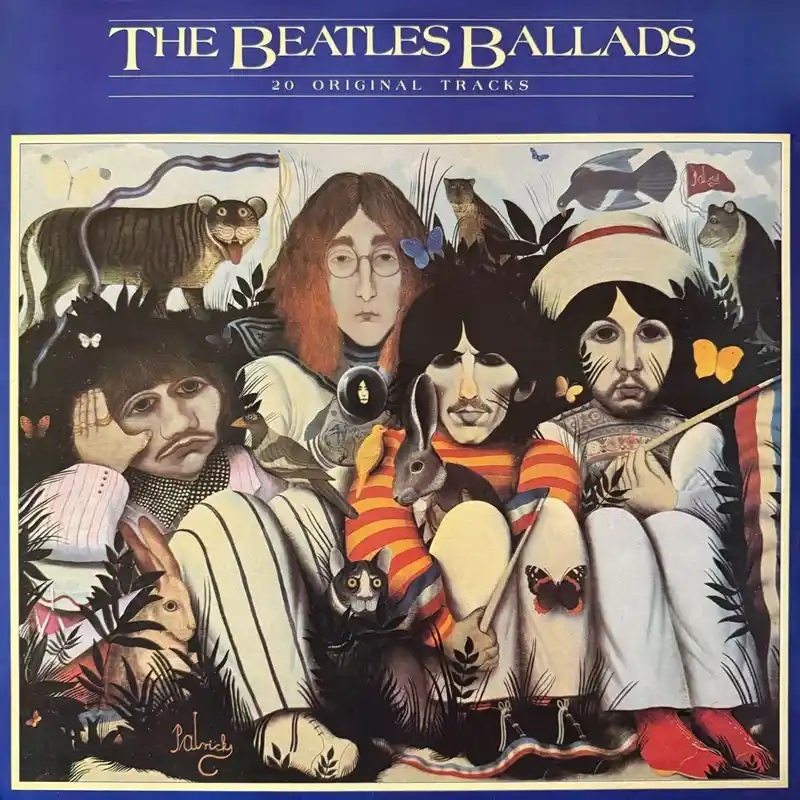
- Cover Artwork: John Byrne, credited as Patrick
- Why It Matters: A post-breakup compilation that repackaged The Beatles as ballad writers and gave unused 1960s artwork a new life
What The Beatles Ballads Album Actually Is
The Beatles Ballads is a compilation album, not a new Beatles project. Every track had already been released before 1980. Its importance lies in selection, packaging, and catalogue history rather than new music.
The album presents The Beatles through their quieter and more melodic side. That includes obvious ballads such as “Yesterday”, “Michelle”, “Something”, “The Long And Winding Road”, “Blackbird”, and “Let It Be”, but it also includes tracks that stretch the definition of a ballad, including “All My Loving”, “Nowhere Man”, and “Do You Want To Know A Secret”.
That looseness is part of the album’s character. It is not a strict musicological definition of the Beatles ballad. It is a record-company listening idea: a softer Beatles album for buyers who wanted melody, familiarity, and emotional warmth rather than a chronological history or a rock-focused compilation.
How It Differs From Love Songs
The most obvious comparison is Love Songs, released in 1977. Both albums package The Beatles around softer material, but they are not the same thing. Love Songs is a double album built around romance and gift-album presentation. The Beatles Ballads is a shorter, tighter single LP aimed more broadly at reflective and melodic Beatles songs.
There is overlap in mood, but the framing is different. Love Songs sells The Beatles as romantic writers. The Beatles Ballads sells them as craftsmen of softer pop, folk-influenced writing, reflective album tracks, and emotional standards.
That distinction matters for BeatlesFan.Club because both pages can exist without duplicating each other. The 1977 album belongs to the romance-and-gift market. The 1980 album belongs more to the late catalogue-compilation era, with one of the most distinctive sleeves attached to any post-breakup Beatles album.
Why The Album Appeared In 1980
By 1980, Beatles compilations had become a regular part of the post-breakup catalogue. The Red and Blue albums had provided career summaries. Rock ‘n’ Roll Music had sold the group as roots-driven rockers. Love Songs had packaged them for the romantic market. Rarities had gathered harder-to-find tracks. The Beatles Ballads continued that pattern by giving buyers another simple theme.
The album also arrived at a strange point. The Beatles had been apart for a decade, yet their catalogue still had enormous commercial value. Record companies did not need new Beatles recordings to create new Beatles products. They needed a theme, a sleeve, a track list, and enough public appetite to make the repackaging worthwhile.
That is why The Beatles Ballads should not be dismissed as random filler. It tells us how the catalogue was being handled before the CD era standardised the official albums and before modern streaming made themed compilations less necessary.
The Beatles Ballads Track Listing
Side One
- “Yesterday“
- “Norwegian Wood (This Bird Has Flown)“
- “Do You Want To Know A Secret“
- “For No One“
- “Michelle“
- “Nowhere Man“
- “You’ve Got To Hide Your Love Away“
- “Across The Universe“
- “All My Loving“
- “Hey Jude“
Side Two
- “Something“
- “The Fool On The Hill“
- “Till There Was You“
- “The Long And Winding Road“
- “Here Comes The Sun“
- “Blackbird“
- “And I Love Her“
- “She’s Leaving Home“
- “Here, There And Everywhere“
- “Let It Be“
The track listing shows why the album is more than a simple romance collection. It includes love songs, breakup songs, folk-flavoured pieces, spiritual or reflective songs, and several tracks that are gentle in sound but complicated in meaning. “For No One” is emotionally devastating rather than sentimental. “She’s Leaving Home” is a family drama. “Nowhere Man” is not a love song at all. That makes the title broader, and looser, than it first appears.
What The Album Gets Right
The strongest thing about The Beatles Ballads is that it reminds listeners how powerful the group’s softer writing could be. The Beatles are often discussed through innovation, studio experimentation, Beatlemania, and rock energy, but their catalogue also contains an unusually deep run of melodic, reflective, and emotionally precise songs.
“Yesterday”, “For No One”, “Blackbird”, “Here, There And Everywhere”, and “Let It Be” alone would make a strong argument for Paul McCartney’s ballad writing. “Norwegian Wood”, “You’ve Got To Hide Your Love Away”, “Nowhere Man”, and “Across The Universe” show Lennon moving into more introspective territory. “Something” and “Here Comes The Sun” make George Harrison essential to the album’s emotional weight.
That balance gives the album a real purpose. It is not the full Beatles story, but it does gather a side of the group that can be underplayed when the focus falls too heavily on hits, noise, or studio invention.
Where The Album Gets Messy
The problem is the word “ballads”. Some tracks fit easily. Others only fit if the word is stretched to mean “softer Beatles songs”. “All My Loving” is bright pop, not a conventional ballad. “Nowhere Man” is reflective but not romantic. “Do You Want To Know A Secret” is gentle early pop rather than a major emotional statement.
That does not ruin the album, but it does expose the compilation logic. The goal was not to create a perfect critical definition. The goal was to make a listenable, marketable Beatles LP with a soft-focus identity.
In that sense, The Beatles Ballads is similar to other post-breakup compilations. The concept is useful, but imperfect. It works best as a mood album and a catalogue object, not as a definitive guide to the Beatles’ emotional songwriting.
The John Byrne Cover Artwork
The cover is one of the main reasons The Beatles Ballads still stands out. The artwork was by John Byrne, credited under the name Patrick, and it gives the album a dreamlike illustrated identity unlike the more straightforward photographic or archive-style packaging used on many Beatles compilations.
The image is often wrongly linked to the abandoned A Doll’s House title for what became The Beatles, better known as the White Album. The safer and better-supported version is that Byrne’s artwork was created for Alan Aldridge’s The Beatles Illustrated Lyrics and was later used for The Beatles Ballads.
That correction matters because it stops the cover from being mythologised incorrectly. The sleeve is important enough without turning it into a lost White Album cover. Its real value is that it gives a fairly ordinary compilation an unusually memorable visual identity.
The Beatles Ballads cover uses John Byrne’s distinctive illustrated Beatles artwork, surrounding the group with animals, butterflies, and dreamlike decorative detail. Its value here is historical as well as visual, because the sleeve became one of the most memorable parts of this 1980 compilation and gives the album a stronger identity than many post-breakup catalogue releases.
Fair Dealing Disclaimer: This low-resolution album cover image is used for identification, review, and historical commentary. Artwork and design remain the property of their respective rights holders.
The Sound And Mix Details
The Beatles Ballads also has collector interest because of its mixes. “Norwegian Wood (This Bird Has Flown)” uses the 1977 mix first used on Love Songs, while most of the other tracks use familiar stereo mixes. Several tracks also share the channel-reversal issue associated with Love Songs.
For ordinary listeners, this is not the main reason to hear the album. For collectors, it is part of the appeal. Post-breakup Beatles compilations often reveal small differences in tape choices, stereo presentation, and catalogue handling.
That is another reason the album should not be treated only as a casual soft-song playlist. It belongs to a particular period of Beatles catalogue history, when older mixes and repackaged LPs still produced small but noticeable differences for serious buyers.
The Single-LP Problem
One of the strangest things about The Beatles Ballads is that it was issued as a single LP even though it runs close to an hour. That is long for a vinyl album, and it helps explain why the record can feel physically and sonically cramped compared with a more generous double-album presentation.
This was not a luxury package like Love Songs. It was a compact themed compilation. That made it cheaper and simpler, but it also forced 20 tracks onto two sides of vinyl.
The result is another example of how the post-breakup catalogue was shaped by practical and commercial decisions. The songs were strong, the idea was simple, and the format was economical.
How The Beatles Ballads Performed Commercially
In Britain, The Beatles Ballads reached No. 17 on the Official Albums Chart. That was not a major chart triumph by Beatles standards, but it still shows there was a market for another themed catalogue release in 1980.
The album was more significant in some overseas markets. It was not issued as a standard US album, but it did appear in countries including Australia, Canada, New Zealand, Germany, Italy, Spain, India, Japan, South Korea, and others. In Australia, it became especially successful, spending several weeks at No. 1.
That international pattern matters. The Beatles Ballads was not one of the universal global Beatles albums known by every casual listener, but it was still part of the worldwide post-breakup catalogue machine. Different countries continued to receive different Beatles products, even after the group itself had disappeared.
Why The Beatles Ballads Was Never A Core Catalogue Album
The hard truth is that The Beatles Ballads is not essential for modern listening. It was not absorbed into the core Beatles catalogue, and it has never become a standard CD-era or streaming-era album in the way the original UK studio albums, Magical Mystery Tour, or Past Masters did.
That is not surprising. The album’s job was temporary. It gave buyers a themed LP in 1980, but later catalogue standardisation made that role less necessary. Today, the individual songs are easier to hear in their original album settings or through official modern releases.
Its value now is historical. It shows how The Beatles were being packaged between the vinyl era of scattered compilations and the later CD-era attempt to make the catalogue cleaner and more consistent.
Why The Beatles Ballads Album Still Matters
The Beatles Ballads Album still matters because it captures a specific way of reading the Beatles catalogue. It presents them not as rock revolutionaries, not as album-era experimenters, and not as Beatlemania idols, but as writers and performers of softer, more reflective songs.
That view is incomplete, but useful. The Beatles really did have an extraordinary ballad tradition, from early tenderness to late spiritual and emotional weight. Even when the compilation stretches the definition, it still reminds listeners that melody and vulnerability were central to the band’s power.
The album also matters because of the sleeve. For many collectors, The Beatles Ballads is remembered as much for its John Byrne artwork as for the track list. That makes it one of the more visually distinctive Beatles compilations, even if it is not one of the most musically necessary.
Where To Find The Beatles Ballads
- Original 1980 UK LP – Parlophone PCS 7214.
- International LP and cassette editions – including releases in Australia, Canada, New Zealand, Germany, Italy, Spain, India, Japan, and other markets.
- Modern official Beatles albums and collections – the individual songs are now best heard through the standard catalogue rather than this out-of-print compilation.
Take A Listen
The Beatles Ballads is not the cleanest modern streaming route through this material. The original 1980 album is best understood as a historical compilation, while the songs themselves are now easier to hear through the standard Beatles albums and current official catalogue releases.
The best way to approach the album today is to treat it as a 1980 listening idea. Play the track list in order and the pattern becomes clear: The Beatles are being presented as melodic, reflective, and emotionally direct, even when the songs are more complicated than the word “ballads” suggests.
Once you have heard it, tell us in the Beatles Fan Club Forum whether The Beatles Ballads works as a soft Beatles compilation, or whether its greatest strength is really the John Byrne sleeve.
Sources And References
- JPGR – UK release and track details.
- The Paul McCartney Project – album and artwork background.
- Official Charts – UK chart peak.
- Beatles Australia – Australian release history.
BeatlesFan.Club operates independently and does not affiliate with The Beatles, Apple Corps, Capitol, Parlophone, EMI, or any official rights holders.
