
Beatles Anthology 3 is the third and final original 1990s archive album in The Beatles’ Anthology series, released on 28 October 1996. Where Beatles Anthology 1 covers the rise and Beatles Anthology 2 captures the mid-period studio leap, this set moves into the fractured but fascinating final chapter: the White Album, the Get Back/Let It Be sessions, and the making of Abbey Road.
Its real value is that it lets you hear the last Beatles years without the usual myth-making flattening everything into a simple breakup story. Much of the material comes from 1968 and 1969, but the set also reaches into early 1970 and opens with “A Beginning”, George Martin’s short orchestral piece originally intended as an introduction to “Don’t Pass Me By” before being left unused.
That alone tells you what kind of archive this is: not just alternate takes, but abandoned ideas, demos, jams, and work-in-progress versions that show how unfinished the Beatles’ final period often was before the records were shaped into their released form.
The strongest material is not just the obvious White Album overflow. You get the Esher demos from George Harrison’s house at Kinfauns, a radically different acoustic “While My Guitar Gently Weeps”, the long-unreleased “Not Guilty”, rough Savile Row performances from January 1969, and early views of later Abbey Road songs such as “Something”, “Come Together”, and “Because”.
It also preserves “Come And Get It” in the one-take demo Paul McCartney cut for Badfinger, which makes the set unusually useful for hearing a Beatles song handed over to an Apple artist almost in real time.
In other words, “Anthology 3” is where the archive becomes most revealing: you can hear the Beatles still producing first-rate ideas even while the group itself was becoming harder to hold together.
Key Facts
- Release Date: 28 October 1996
- Recorded: 28 May 1968 to 3 January 1970; plus 22 February 1967 for the borrowed final chord from “A Day In The Life” heard at the end of “The End”.
- Studio: EMI Studios and Apple Studio, London
- Genre: Rock
- Album Duration: 145:33
- Record Label: Apple, Capitol
- Producer / Archive Compiler: George Martin
2025 Anthology Collection Update
In 2025, Apple expanded the Anthology project with The Beatles Anthology Collection, remastering the original three Anthology albums and adding Anthology 4. That does not change what Anthology 3 was in 1996, but it does change how the album now sits in the current catalogue: it is no longer the final Anthology-branded release, only the final volume from the original 1990s archive run.
Performers
Anthology 3: CD Song Listing
Anthology 3: Disc One
Anthology 3: Disc Two
Due to space restrictions, the CD edition has two discs, while the vinyl version spreads the material across three LPs. Anthology 3 was also issued on cassette.
Kinfauns, mentioned several times in the track list, was George Harrison’s house in Esher, Surrey, where The Beatles taped the now-famous Esher demos in May 1968 before starting the White Album sessions properly at EMI. Those home recordings are one of the set’s biggest draws because they strip the songs back to voice, guitar, and atmosphere, often making familiar material feel newly exposed.
Album Cover
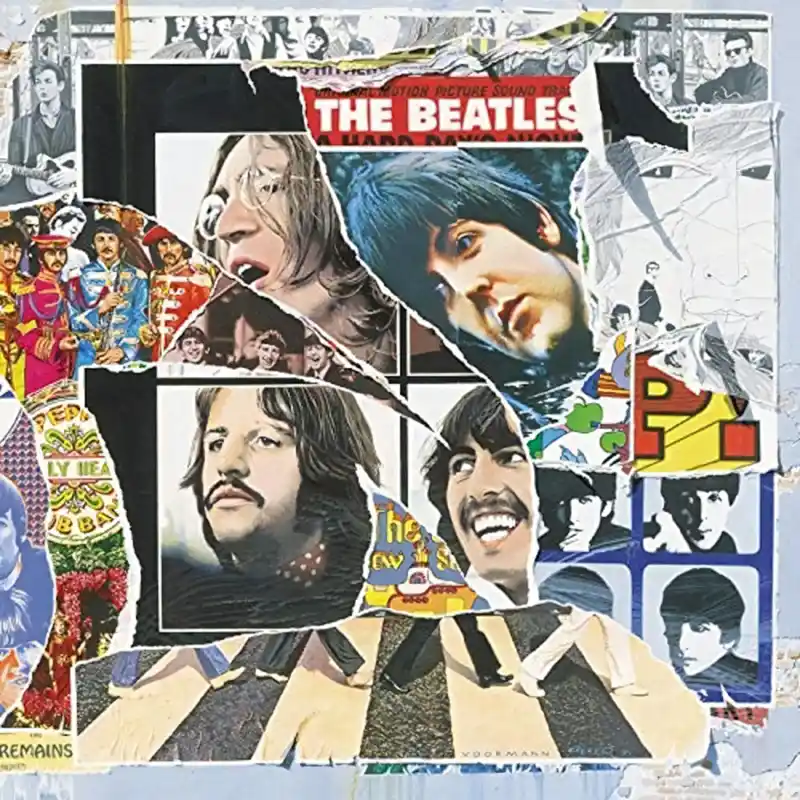
Like the first two volumes, “Anthology 3” uses Klaus Voormann’s torn-collage design rather than a straightforward period photograph.
That is the correct visual language for this series: the Anthology albums are about excavation, reconstruction, and fragments being pulled back into view, so the ripped layers work far better than a clean retrospective sleeve would have done.
On this third volume the imagery leans into the late Beatles years, but it still does not function as a strict documentary timeline. It is part of the larger triptych, and one of the more interesting details is that Voormann inserted an updated self-portrait into Harrison’s hair within a section of the Revolver artwork. That kind of hidden visual joke gives the cover more value than a generic “album covers on a wall” summary.
Fair dealing note: The cover image is shown for criticism and review under UK fair dealing. Artwork, logos, trademarks, and related rights remain with their respective owners. BeatlesFan.Club operates independently and does not affiliate with The Beatles, Apple Corps, or any official rights holders.
Anthology 3: Chart Success
“Anthology 3” did not match the UK peak of the earlier volumes, but it was still a major international release. In the UK it reached No. 4, while in the US it hit No. 1 on the Billboard 200. That matters because by late 1996 the novelty of the Anthology project had already faded somewhat, yet this was still a double-CD archive release of outtakes and demos performing like a frontline catalogue event.
It also continued a notable US run: Anthology 3 became another Beatles No. 1 on the Billboard 200, following the earlier success of Anthology 1 and Anthology 2. In commercial terms, that is one of the clearest signs that the archive series was not just being bought by completists. There was still a large audience for hearing the Beatles’ late-period work in raw, unfinished form.
Why Anthology 3 Had No New Beatles Single
Unlike Anthology 1 and Anthology 2, this volume did not launch with a newly completed Lennon demo. The plan had been to tackle “Now And Then” after “Free As A Bird” and “Real Love“, but the project stalled and the track was left unfinished during the original Anthology era. In its place came “A Beginning”, George Martin’s orchestral cue intended in 1968 as a possible introduction to “Don’t Pass Me By”.
That abandoned third single became one of the longest-running loose ends in Beatles history. “Now And Then” was finally completed and released in 2023, which retroactively makes Anthology 3 even more interesting: it is the original Anthology album shaped around the reunion track that did not arrive on time.
Take A Listen To The Album
Use the player below to sample the album, then continue the discussion in the Beatles Fan Club Forum.
Prefer not to load the Spotify player? Open the album on Spotify.
Sources And References
- The Beatles – Anthology 3 release date and track listing.
- The Beatles – 2025 Anthology music collection overview.
- Official Charts – Anthology 3 UK chart history.
- Billboard – Beatles US album chart context.
BeatlesFan.Club operates independently and does not affiliate with The Beatles, Apple Corps, or any official rights holders.
