
Abbey Road is The Beatles‘ eleventh studio album, released on 26 September 1969 in the UK. It was the last Beatles album to be recorded, even though Let It Be was the final album released.
Recorded mainly at EMI Studios on Abbey Road (with sessions also at Olympic and Trident Studios), the album captures the band pulling together for one final, high-level studio statement: a set of fully formed songs on side one, and the famous side two medley that plays like a continuous suite.
Key Facts About The Abbey Road Album
- Release Date: 26 September 1969 (UK); 1 October 1969 (US)
- Recorded: 22 February to 20 August 1969
- Running Time: 47:23 (original UK stereo LP)
- Label: Apple Records
- Studios: EMI (Abbey Road), Olympic and Trident Studios, London
- Genre: Rock, pop
- Producer: George Martin
- Engineers (Key Credits): Geoff Emerick, Phil McDonald, Jeff Jarratt, Tony Clark, and others
Notable Additional Production (Select Sessions): Chris Thomas (when Martin was unavailable on some dates)
Where The Abbey Road Album Sits In The Beatles Story
They recorded most of the Let It Be material earlier, primarily in January 1969. Abbey Road came afterwards when the group returned to “proper” studio craft: tighter arrangements, heavier use of overdubbing, and George Martin back in the producer’s chair.
The irony is the point: Let It Be was the last release, but Abbey Road is the last time the Beatles built an album in the classic sense – conceived, tracked, polished, and sequenced as a complete studio work.
Sound, Recording, And New Technology
Abbey Road’s sound is noticeably cleaner and more modern than the earlier Beatles records. Part of that comes from the recording setup at EMI: the album was made using eight-track recording and a then-new solid-state EMI mixing console (rather than the older valve desks). The result is a smoother, more controlled tone – especially obvious on the vocals, bass, and the “shine” of the guitars.
You also hear the band embracing late-60s studio colour without losing songcraft: the Moog synthesiser appears across the album (subtle in places, prominent in others), and the production is packed with purposeful details (layered harmonies, orchestral scoring where it adds impact, and hard edits that make the medley snap from section to section).
Key Performers
- John Lennon – vocals, guitars, keyboards (select tracks)
- Paul McCartney – vocals, bass, guitars, keyboards (select tracks)
- George Harrison – vocals, guitars, keyboards (select tracks)
- Ringo Starr – drums, percussion, vocals (select tracks)
- George Martin – producer; keyboards and orchestral scoring where used
Guest Musician: Billy Preston – Hammond organ (notably on “Something” and “I Want You (She’s So Heavy)”)
The Tracks And Lead Vocalists
Side One
- Come Together – Lennon
- Something – Harrison
- Maxwell’s Silver Hammer – McCartney
- Oh! Darling – McCartney
- Octopus’s Garden – Starr
- I Want You (She’s So Heavy) – Lennon
Side Two
- Here Comes The Sun – Harrison
- Because – Lennon / McCartney / Harrison
- You Never Give Me Your Money – McCartney
- Sun King – Lennon / McCartney / Harrison
- Mean Mr Mustard – Lennon
- Polythene Pam – Lennon
- She Came In Through The Bathroom Window – McCartney
- Golden Slumbers – McCartney
- Carry That Weight – McCartney / Lennon / Harrison / Starr
- The End – McCartney
- Her Majesty – McCartney
The Side Two Medley Explained
Side two is the album’s signature move: a linked suite that runs from “You Never Give Me Your Money” into “The End”, using tight edits, shared motifs, and recurring musical ideas. The point is flow, not individual tracks. If you chop it up, you lose what makes it work.
The “hidden track” twist is “Her Majesty”, which appears after a short gap at the very end. It was originally intended to sit inside the medley, was removed, then accidentally preserved and appended to the master (with added leader tape) – turning it into one of the earliest famous “hidden tracks”. There was also another “hidden track” on Sgt. Pepper’s, but that was described as the “inner groove”.
Abbey Road Album Cover
The cover might be the most recognisable album image in popular music: the band crossing the zebra crossing outside EMI Studios on Abbey Road.
These key facts matter because people repeat them incorrectly online:
The band considered the working title “Everest”, but they ultimately named the album after the street and the studio.
Iain Macmillan took the photo on 8 August 1969. Macmillan worked fast, shooting six frames in a short window while a policeman briefly held the traffic.
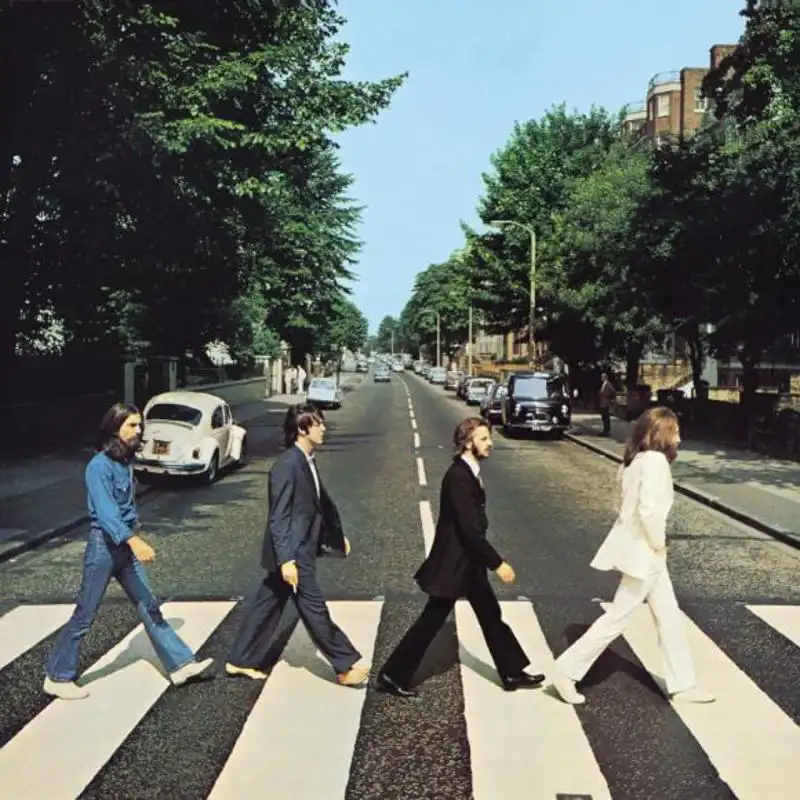
The finished sleeve is famously minimal: no band name, no album title on the front cover – because by 1969, they didn’t need it.
Disclaimer: This low-resolution album cover image is used under fair dealing for review, criticism, and identification. Copyright remains with the rights holder.
Iconic Abbey Road Crossing
The Abbey Road crossing became a pilgrimage site almost instantly, and it has stayed that way for decades. If you want to see the current reality (constant tourist recreations), you can view the Abbey Road webcam live right here.
Paul Is Dead Theory
The cover later became tied to the “Paul Is Dead” conspiracy theory, but that belongs more to the album’s cultural afterlife than to the record itself. For the full story, see our dedicated Paul Is Dead page.
Chart Success And Major Singles
Abbey Road was a commercial monster on release.
- UK Albums: 17 weeks at Number 1 in total (the first 11 consecutive).
- US Albums: 11 weeks at Number 1.
- Key Single: “Something / Come Together” (double A-side)
- UK Singles Peak: Number 4
- US Hot 100: Number 1
What To Listen For (On The Full Abbey Road Album)
If you want the quick “why this album lasts” checklist, it’s this:
- McCartney’s bass is mixed with real authority (deep, melodic, and forward).
- The vocal blend on “Because” is one of the tightest harmonies the band ever recorded.
- The medley is Beatles-level sequencing: unfinished ideas turned into a coherent suite through editing, arrangement, and pacing.
- Harrison arrives fully formed as an A-side writer with “Something” and “Here Comes The Sun” on the same album.
Take A Listen
Click play to have a brief listen to each track. Got a favourite moment on the album (or a hot take on the medley)? Post it in the Beatles Fan Club Forum.
Prefer not to accept optional cookies? Open this album on Spotify.
Sources And References
- The Beatles – Official album overview and headline chart summary.
- Official Charts Company – UK album chart statistics for Abbey Road.
- Official Charts Company – UK single chart statistics for Something/Come Together.
- Abbey Road Studios – Cover photo session details (six shots, stepladder, traffic held).
- Abbey Road Studios – EMI TG12345 console background and its role in the Abbey Road sound.
BeatlesFan.Club operates independently and does not affiliate with The Beatles, Apple Corps, or any official rights holders.
