
20 Forthlin Road matters on BeatlesFan.Club because it was not just Paul McCartney’s childhood address. It was one of the most important working spaces in early Beatles history: a modest post-war Liverpool house where John Lennon and Paul McCartney met, rehearsed, wrote, argued, refined ideas, and helped turn a local friendship into the most famous songwriting partnership in popular music.
That is why this page should be more than a tourist summary. 20 Forthlin Road tells several stories at once: Paul’s family life after tragedy, the ordinary social-housing world from which the Beatles emerged, the early Lennon-McCartney writing process, and the way an unremarkable terraced house became one of the key birthplaces of modern pop.
20 Forthlin Road: Key Facts
- Address: 20 Forthlin Road, Allerton, Liverpool, L18 9TN
- Built: 1949
- Paul McCartney Lived Here: 1955 to about 1964
- Historic Status: Grade II listed since 2012
- Owned By: National Trust since 1995
- Why It Matters: Early Beatles songs were written, rehearsed, and developed here
- Estimated Song Connection: Up to 100 songs are believed to be linked with the house
Why 20 Forthlin Road Matters
Forthlin Road is often described as one of the places where the Beatles were born, and that is fair so long as the claim is kept in proportion. The band did not spring fully formed from one front room, but this house became one of the most important environments in which the young Lennon and McCartney partnership grew. They worked here, rehearsed here, and tested early songs here in a home that felt very different from Mendips.
That difference matters. National Trust material stresses that Mendips and 20 Forthlin Road came from different social worlds, with Paul’s house being smaller, plainer, and rooted in post-war local-authority housing. That modest setting is part of the point. The Beatles did not come out of grandeur. They came out of ordinary Liverpool rooms filled with grief, family pressure, humour, guitars, tea, cigarettes, and stubborn creative ambition.
The McCartney Family Home
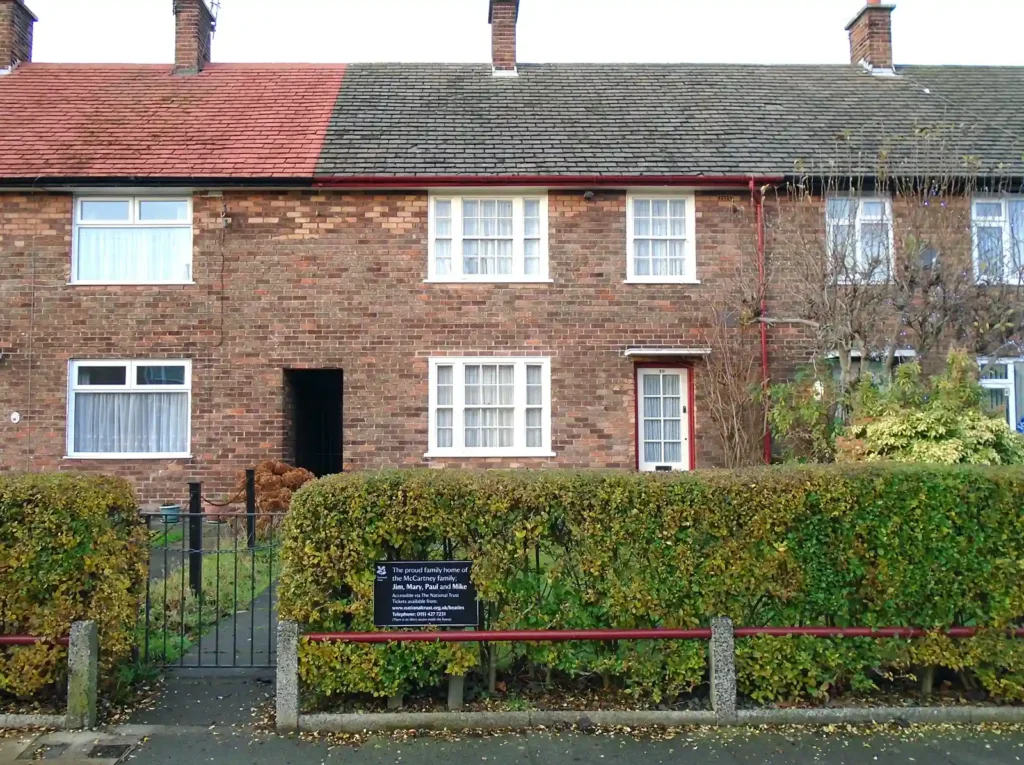
Paul moved to 20 Forthlin Road with his parents, Jim and Mary McCartney, and his brother Mike in 1955. One of the most useful small details about the house is that Paul’s parents chose it partly because it had a telephone, which was important for Mary’s work as a midwife. That is exactly the sort of ordinary practical fact that keeps the story grounded.
The family did not have long to enjoy that new home together. Mary McCartney died in 1956, only about a year after the move, and the emotional effect of that loss sits quietly behind almost every serious account of Paul’s early life. Forthlin Road therefore matters not only as a music address but also as the house in which Paul learned to live with grief, responsibility, and the kind of inwardness that would feed his songwriting.
Where Lennon And McCartney Worked
The most valuable part of the house for Beatles history is not the exterior but the layout inside. Historic England records that the front ground-floor room was used by the Beatles for composing songs, while the smaller rear room was used for rehearsing. That distinction is worth preserving because it turns a vague legend into something more physical and believable: ideas in one room, noise and practice in another.
National Trust history material specifically links 20 Forthlin Road with the coming-into-being of She Loves You, I Saw Her Standing There, and Love Me Do. Those are not minor titles. They are songs from the period when the Beatles stopped being a promising Liverpool act and became a national force.
Songs Linked With 20 Forthlin Road
Exact long lists vary from source to source, and it is better to admit that than to pretend every title can be pinned down with total certainty. Still, 20 Forthlin Road is strongly associated with a remarkable cluster of early McCartney and Lennon-McCartney writing, development, or rehearsal. Among the songs most often linked with the house are:
- I Lost My Little Girl
- Love Me Do
- I Saw Her Standing There
- I’ll Follow The Sun
- When I’m Sixty-Four
- She Loves You
- One After 909
- Michelle
- Hold Me Tight
- I Call Your Name
- I’ll Get You
- Thank You Girl
- From Me To You
- Bad To Me
The most important point is not whether one fan’s count lands on 21 songs and another’s on 27. The key fact is that the house was a genuine songwriting engine. It was where early ideas were tried, discarded, refined, and turned into the material that built the Beatles’ first era.
Paul’s First Song At Forthlin Road
One of the best details connected to the house is that Paul has identified I Lost My Little Girl as the first song he ever wrote. That matters because it gives 20 Forthlin Road a claim older and more intimate than the Beatles’ recording career. Before the charts, before EMI, before Beatlemania, there was a teenager in this house teaching himself how songs could work.
That also helps explain why the building matters to songwriters and not only to Beatles tourists. Forthlin Road was not just a place where famous songs happened to be written. It was the place where Paul learned that he could write them at all.
What Survives Inside The House
Another strong reason to keep this page is that the house itself still tells the story unusually well. Historic England notes that the National Trust restored details to bring it back towards its late-1950s character. The front room contains Chinese-style wallpaper recreated from a surviving fragment, the kitchen still has an original quarry-tiled floor, and the overall effect is not one of polished museum grandeur but of a lived-in family home.
That authenticity matters because it prevents the site from becoming an empty shrine. You can still understand the scale of the rooms, the plainness of the setting, and the way ordinary domestic space could also function as a rehearsal room and songwriting workshop. Mike McCartney’s larger rear bedroom even doubled as a darkroom, which adds another good family detail often lost in shorter accounts.
The House Today
20 Forthlin Road is now cared for by the National Trust and is visited as part of a combined tour with Mendips. That is the only normal way to see inside both houses properly. The National Trust also makes clear that indoor photography is not allowed, although visitors do have time to take pictures outside.
That restriction is actually part of what keeps the house special. It forces visitors to experience the place as a guided historical environment rather than as a quick phone-camera stop. For people who cannot visit, it also explains why public glimpses of the interior remain relatively unusual and why filmed visits still feel valuable.
Why 20 Forthlin Road Still Matters On BeatlesFan.Club
20 Forthlin Road still matters because it gives the Beatles story a human scale. The band became global, but the beginnings were domestic: a family house, a modest parlour, a back room for rehearsals, a father trying to raise two sons after loss, and a teenager slowly realising he could write songs that might last.
It also matters because it anchors the Lennon-McCartney story in a real place that still survives. For Beatles fans, that makes it more than a plaque address. It is one of the rare locations where the leap from ordinary Liverpool life to world-changing music still feels tangible.
Take A Look
Watch Paul McCartney revisit 20 Forthlin Road during Carpool Karaoke, one of the best public glimpses of the house and its emotional hold on him. Continue the discussion on the Beatles Fan Club Forum.
If you’d rather not load the YouTube player on this page, open the video directly on YouTube instead.
Sources And References
- National Trust – House history, songs, and family background.
- Historic England – Listing, restoration, interiors, and significance.
- Paul McCartney – “I Lost My Little Girl” as first song.
- National Trust – Booking and photography rules.
BeatlesFan.Club operates independently and does not affiliate with The Beatles, Apple Corps, or any official rights holders.
