
This page is about the Beatles For Sale EP, not the 1964 album of the same name. If you want the parent LP instead, see Beatles For Sale. The EP matters for a different reason: issued in the UK on 6 April 1965, it turned four songs from the album into a separate short-format release at a point when EMI was still finding new ways to keep Beatles product moving through the shops.
That makes it more interesting than a routine spin-off. The album had already been out for four months, the band had moved on to recording Help!, and yet Beatles demand remained strong enough for EMI to repackage four Beatles For Sale tracks as another major EP.
Even more tellingly, three of the four songs had reportedly been considered as the Beatles’ final single of 1964 before John Lennon came up with “I Feel Fine”. So this was not a random grab-bag. It was a compact release built from material that had once been close to being pushed even harder.
Beatles For Sale EP: Key Facts
- Release Date: 6 April 1965
- Format: 7-inch vinyl EP, 45 RPM, mono only
- Catalogue Number: Parlophone GEP 8931
- Tracks: Four
- Source Album: Four tracks from Beatles For Sale
- Recording Period: Sessions from August to October 1964 at EMI Studios, London
- Running Time: 9:31
- Producer: George Martin
- Sleeve Notes: Tony Barrow
- UK Chart Performance: Number 1 on the EP chart for 6 weeks across 2 runs; 47 weeks on chart
Why The Beatles For Sale EP Mattered
The obvious criticism is easy enough: every track was already available on the album. However, that misses the point of British EPs in the mid-1960s. They were cheaper than LPs, still strong enough to chart in their own right, and useful for selling high-demand catalogue to buyers who either could not afford the full album or wanted a concentrated Beatles release in a smaller format.
This EP also shows EMI making a more selective choice than some fan pages admit. Instead of just lifting any four songs from the album, it combined two Lennon originals, one Chuck Berry cover, and “Eight Days A Week”, which would soon become a huge US single. That gave buyers a package with both commercial and musical range: introspection, country-tinged melancholy, straight rock ‘n’ roll, and one of the Beatles’ strongest pop hooks.
Track Listing
Side A
Side B
Why These Four Songs Were Chosen
This is where the EP becomes more revealing than it first appears. As Derek Taylor later noted, at least three Lennon-McCartney songs from Beatles For Sale had been considered as possible single releases before Lennon produced “I Feel Fine“. Graham Calkin identifies three of the EP’s four tracks as having belonged to that conversation.
The exception was “Rock And Roll Music”, which was never a serious single option because it was a cover and the Beatles had moved beyond using other writers’ songs for their own A-sides.
That makes the EP feel less accidental. It was built around material EMI already knew was strong. Instead of wasting those near-single contenders, the label repurposed them in a four-track format that could still sell heavily. In that sense, the EP acts almost like a shadow version of the single strategy the Beatles did not quite take at the end of 1964.
What The EP Actually Offered
The sequence is sharper than it looks on paper. “No Reply” opens with one of Lennon’s most emotionally direct early vocals, while “I’m A Loser” pushes even further into self-examination and country-inflected phrasing. Then side two swings hard into Chuck Berry territory with “Rock And Roll Music” before ending on “Eight Days A Week”, the brightest and most commercially obvious song in the set.
That gives the EP a shape many Beatles EPs do not have. It starts with darker, more inward-looking Lennon material and ends in crowd-pleasing energy. In miniature, it also reflects what made Beatles For Sale more interesting than its sometimes tired reputation suggests: the album mixed exhaustion, introspection, covers from the Beatles’ stage past, and some of their most melodic late-1964 writing.
Performers And Recording Details
- John Lennon: lead vocal on “No Reply”, “I’m A Loser”, and “Rock And Roll Music”; acoustic guitar; harmonica; handclaps
- Paul McCartney: co-lead vocal on “No Reply”; bass guitar; harmony vocals; handclaps
- George Harrison: acoustic and electric guitar; backing vocals; handclaps
- Ringo Starr: drums; tambourine; handclaps
- George Martin: piano
The spread of performances matters here because it helps explain the EP’s range. Lennon dominates the mood of side one, Berry’s song lets the band reconnect with its stage roots, and “Eight Days A Week” brings back the polished studio confidence that was already pushing the Beatles beyond straight beat-group material.
Beatles For Sale EP: Sleeve And Packaging
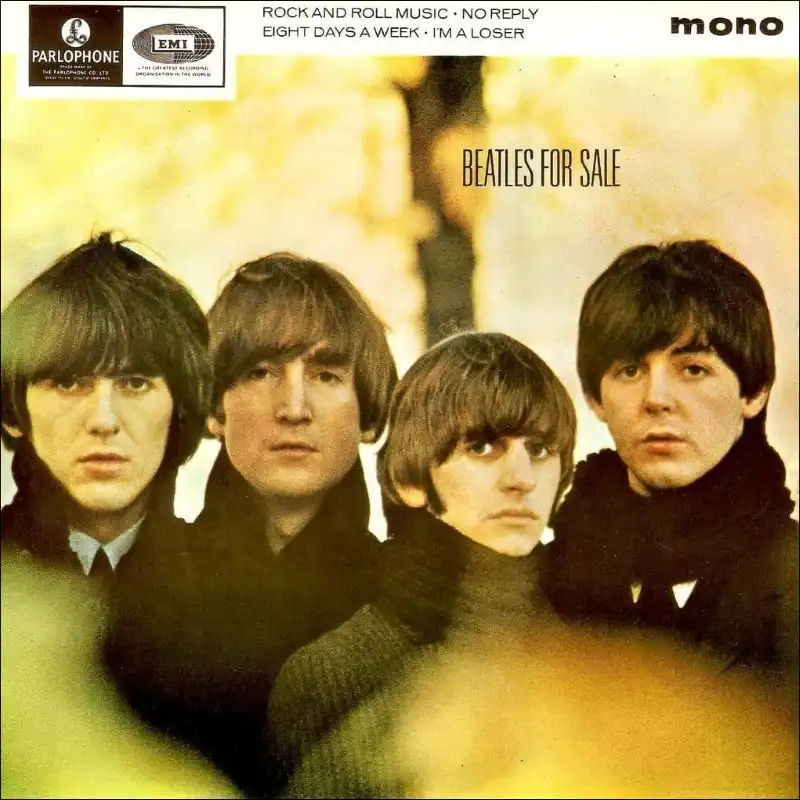
The sleeve works because it does not try to reinvent the album image. Instead, it reproduces Robert Freeman’s autumnal Beatles For Sale portrait almost intact, keeping the close-up faces, the muted colours, and the tired, unsmiling mood that made the parent LP look so different from the brighter confidence of A Hard Day’s Night. On an EP, that same image feels even more concentrated. It turns the record into a compact fragment of the album’s atmosphere rather than a separate visual statement.
That matters because the sleeve quietly reinforces the musical selection. This is not a jaunty greatest-hits package. It looks weary, inward, and autumnal, which suits “No Reply” and “I’m A Loser” far better than a more cheerful design would have done. Even the inclusion of “Rock And Roll Music” and “Eight Days A Week” does not break that mood entirely, because Freeman’s photograph keeps the whole package anchored in the more serious texture of late-1964 Beatles imagery.
Collecting And Pressing Details
Collectors watch the pressing details closely here too. First issues came in mono only with matrix numbers 7TCE 860-2 and 7TCE 861-3, the embossed KT tax code on side two, and Tony Barrow sleeve notes. Original labels began with “The Parlophone Co. Ltd.” and carried the old resale-price wording across the push-out centre.
Later copies changed those details. Post-1965 re-pressings switched to “The Gramophone Co. Ltd.”, while 1970s copies dropped the old resale-price text altogether. Sleeve quality also declined, with later covers usually looking thinner and less sharply printed. That kind of detail matters because Beatles EPs were treated as proper catalogue items, and the differences between pressings are easy to spot once you know what to look for.
Fair Dealing Disclaimer: Low-resolution image used for identification, criticism, review, and historical commentary relating to the Beatles For Sale EP sleeve and packaging. All rights remain with the copyright holder.
Beatles For Sale EP: Chart Success
The EP entered the UK EP chart on 10 April 1965 and reached number 1 two weeks later. It then spent five straight weeks at the top from 24 April before returning for one more week on 12 June. In total it remained on the chart for 47 weeks, which is a far stronger run than many casual discography summaries mention.
That chart run also helps explain why EMI hurried out a companion sequel, Beatles For Sale No. 2, less than two months later. The first EP had already proved there was still money and demand in the album, even after the LP itself had been available for months.
Where To Find The Songs
- All four tracks appear on Beatles For Sale.
- “Eight Days A Week” became a US single and reached number 1 there in March 1965.
- “No Reply” and “I’m A Loser” appeared in the US on Beatles ’65.
Why This EP Still Deserves Its Own Page
Beatles For Sale deserves its own EP page because it was not just another repackaging exercise. It pulled together a group of songs that had almost served a bigger purpose, preserved the sombre visual identity of the parent album, and proved that Beatles EPs could still be major sellers well into 1965. That gives it more weight than a casual glance at the track list might suggest.
Seen that way, the record becomes more than a four-song sampler. It is a compact document of how EMI managed Beatles demand between albums, how strong the Beatles For Sale material remained after Christmas 1964, and how even a short-format release could be built with enough care to feel like a serious part of the catalogue rather than a throwaway extra.
Have your own thoughts on the EP? Join the discussion in the Beatles Fan Club Forum.
Sources And References
- The Beatles – Beatles For Sale album background and release context.
- The Beatles – Eight Days A Week song background and single context.
- The Beatles – No Reply song background.
- Graham Calkin’s Beatles Pages – EP chart, sleeve, and pressing details.
