
This page is about the Beatles EP Extracts From The Album A Hard Day’s Night, not the film EP issued two days earlier. It was the group’s seventh official British EP, and its job was different: to package four songs from A Hard Day’s Night that were on the album but not actually heard in the finished film.
That makes it a more revealing record than it first appears. The companion Extracts From The Film A Hard Day’s Night EP sold the songs cinemagoers had already seen and heard on screen. This second EP mopped up the rest. In other words, EMI split the soundtrack in two and marketed both halves separately, which tells you a great deal about how efficiently Beatles demand was being mined by late 1964.
Extracts From The Album A Hard Day’s Night EP: Key Facts
- Release Date: 6 November 1964
- Format: 7-inch vinyl EP, 45 RPM, mono only
- Catalogue Number: Parlophone GEP 8924
- Tracks: Four
- Recording Dates: 1 and 2 June 1964 at EMI Studios, London
- Running Time: 9:17
- Producer: George Martin
- Sleeve Notes: Tony Barrow
- Source: Four A Hard Day’s Night album tracks not featured in the film
- UK Chart Performance: Number 8 on the EP chart; 17 weeks on chart
Why This EP Mattered
The first thing to understand is that this EP was not a random leftover bundle. EMI had already issued the film-focused companion EP, so this second one existed to complete the picture. It gathered four soundtrack-album songs that buyers knew from the LP but had not actually seen used in the film. That made it less glamorous than its sibling, but also more interesting as a piece of catalogue planning.
It also captured the less obviously cinematic side of A Hard Day’s Night. These songs did not come with the instant visual memory of train compartments, TV studio chaos, or performance scenes. Instead, they had to stand on the strength of the writing and the record-making alone. That gives the EP a quieter identity than the film extracts disc, but not a weaker one.
Track Listing
Side A
Side B
Why It Was Different From The Film EP
This is the point many pages skate past. Extracts From The Album A Hard Day’s Night was the second half of a deliberate two-EP split. The earlier record gathered songs heard in the film. This one used the four soundtrack-album tracks that cinemagoers had not heard in the finished picture: “Any Time At All”, “I’ll Cry Instead”, “Things We Said Today”, and “When I Get Home”.
That distinction matters because it gives this EP a more purely album-based identity. It is less about on-screen memory and more about the strength of the Beatles’ 1964 songwriting. It also means that, with this release, every side-two track from the British album except “I’ll Be Back” was available on 45 RPM by late 1964, which is exactly the sort of precise catalogue slicing EMI had become very good at.
What The Extracts From The Album A Hard Day’s Night EP Actually Offered
The selection is stronger than its chart peak might suggest. “Any Time At All” is a hard-driving Lennon rocker with a pounding piano figure. “I’ll Cry Instead” adds a country-tinged edge and a more brittle Lennon vocal mood. “Things We Said Today” brings one of McCartney’s most mature early melodies, and “When I Get Home” closes the set with another Lennon song full of urgency and restless movement.
It also helps that all four tracks are Lennon-McCartney originals. Like the rest of A Hard Day’s Night, this EP belongs to the point where the Beatles had become fully self-contained as writers for their own film-and-album project. That gives it a very different feel from earlier Beatles EPs, which had often mixed originals with covers.
Performers And Recording Details
- John Lennon: lead vocal on “Any Time At All”, “I’ll Cry Instead”, and “When I Get Home”, rhythm guitar, piano on “Any Time At All”
- Paul McCartney: lead vocal on “Things We Said Today”, bass guitar, piano on “Things We Said Today”
- George Harrison: lead guitar, twelve-string guitar, backing vocals
- Ringo Starr: drums, tambourine, cowbell
The recording dates are useful too. “I’ll Cry Instead” was cut on 1 June 1964, while “Any Time At All”, “Things We Said Today”, and “When I Get Home” followed on 2 June. That means this EP captures the last concentrated burst of soundtrack-album work for A Hard Day’s Night, when the Beatles were finishing the less film-specific side of the record at speed.
Extracts From The Album A Hard Day’s Night EP: Chart Success
Commercially, this was the poorer relation of the two companion EPs. It did not enter the UK EP chart until 9 January 1965, climbed only to number 8, and stayed there for 17 weeks. It also failed to reach the singles chart at all. That is a much weaker showing than the film extracts EP, which had a far clearer identity and stronger chart life.
That weaker performance probably tells its own story. Buyers were more interested in the songs they had actually seen and heard in the film than in the soundtrack tracks left off screen. This EP still sold well enough to chart respectably, but it did not carry the same immediate cinematic pull as its sibling.
Extracts From The Album A Hard Day’s Night EP: Sleeve And Packaging
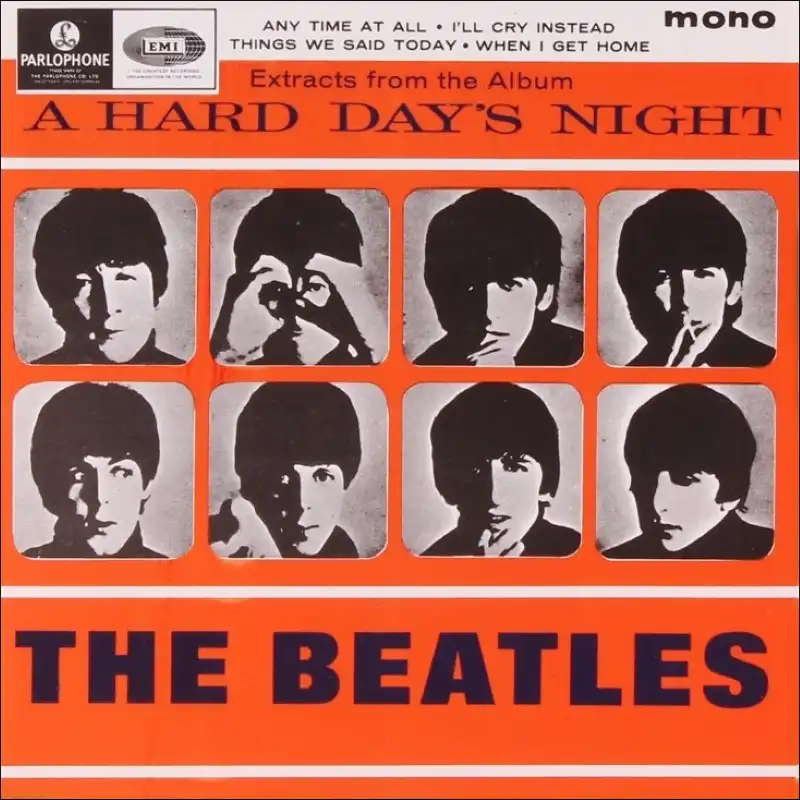
The sleeve is clearly designed as a sister piece to the film EP, but it is not just a colour swap. The orange-red border is louder and more insistent than the purple used on the film extracts sleeve, while the reduced set of black-and-white headshots gives the design more empty space and a slightly harsher, poster-like impact. It still borrows the visual language of the A Hard Day’s Night album, but this version feels more stripped back and more graphic.
That suits the record better than it might seem at first glance. These were the album tracks not tied to finished film scenes, so the sleeve needed to keep the A Hard Day’s Night identity visible while also making this look like a separate purchase. The design does that neatly: same family, different function.
Collecting And Pressing Details
Collectors watch the pressing details closely here as well. First issues came in mono only with matrix numbers 7TCE 850-2N and 7TCE 851-1N, a KT tax code on both sides, and Tony Barrow sleeve notes. Original labels began with “The Parlophone Co. Ltd.” and used “Recording First Published 1964”. Across the push-out centre they also carried the old resale-price wording.
Later pressings changed those details. Post-1965 copies moved to “The Gramophone Co. Ltd.” wording and replaced the older publication line with a circled “P”, while some later sleeves and labels look thinner, smaller, and less sharply printed. That sort of change matters because Beatles EPs were proper catalogue items, and collectors can spot the difference quickly.
Fair Dealing Disclaimer: Low-resolution image used for identification, criticism, review, and historical commentary relating to the Extracts From The Album A Hard Day’s Night EP sleeve and packaging. All rights remain with the copyright holder.
Where To Find The Songs
- All four tracks appear on A Hard Day’s Night.
- “Things We Said Today” was also the UK B-side of “A Hard Day’s Night“.
- In 1964, all four songs were already available in the US as part of Capitol’s reshaped A Hard Day’s Night material.
Why This EP Still Deserves Its Own Page
This EP deserves its own page because it shows the less glamorous but still revealing side of Beatles catalogue management. It was not built around the songs fans remembered from the cinema. It was built around the songs left out of the film, then sold as a companion piece anyway. That is a very different kind of commercial logic, and it says plenty about the scale of demand in late 1964.
Seen that way, Extracts From The Album A Hard Day’s Night becomes more than the weaker sister release. It is a neat document of how thoroughly EMI could segment the Beatles’ output by 1964: film songs here, non-film songs there, both wrapped in closely related sleeves, and both aimed at buyers who would almost certainly have kept coming back for more.
Have your own thoughts on the EP? Join the discussion in the Beatles Fan Club Forum.
Sources And References
- The Beatles – Album context and film-song split.
- The Beatles – I’ll Cry Instead recording details.
- The Beatles – Things We Said Today release details.
- Graham Calkin’s Beatles Pages – EP chart, sleeve, and pressing details.
