
The Beatles’ “All My Loving” EP did not contain new songs, but that does not make it a throwaway release. Issued in the UK on 7 February 1964 as the group’s fourth British EP, it pulled together four already familiar recordings into a compact, mono-only snapshot of early Beatlemania at the precise moment the band was moving from national success to worldwide dominance.
That timing is what makes the record worth covering. EMI chose “All My Loving” as the title even though it had not been released as a British single, because the song had already attracted enough radio airplay to stand out. On the very same day the EP reached the shops, The Beatles landed in New York for their first US visit. This was a small British 7-inch release, but it appeared at the exact point when Beatlemania was becoming an international event.
All My Loving EP: Key Facts
- Release Date: 7 February 1964
- Format: 7-inch vinyl EP, 45 RPM, mono only
- Catalogue Number: Parlophone GEP 8891
- Tracks: Four
- Source Albums: Two songs from With The Beatles and two from Please Please Me
- Recording Period: Sessions from September 1962 to July 1963 at EMI Studios, London
- Sleeve Notes: Tony Barrow
- Production: Mainly George Martin; “P.S. I Love You” single recording produced by Ron Richards
- UK Chart Performance: Number 1 on the EP chart for 8 weeks; number 12 in the singles chart
- Other Territories: Also issued in Sweden, Australia, and New Zealand
Why The All My Loving EP Mattered
The obvious criticism is easy enough: every track had already been released. However, that misses the point. In early 1964 EPs were still a serious commercial format in Britain, and this one was assembled intelligently. It gave buyers the title track from the latest LP, added the hard-edged cover “Money (That’s What I Want)”, and then reached back to the B-sides of the Beatles’ first two UK singles.
That made the EP more than a stopgap. It worked as a compact primer on what made the early Beatles so effective: a first-rate Lennon-McCartney pop song, two strong but less obvious catalogue choices, and one of the tougher R&B performances from their stage repertoire. In one short record, EMI managed to package both sides of the group’s appeal – the polished hit-makers and the club-hardened band.
Track Listing
Side A
- All My Loving – from With The Beatles
- Ask Me Why – B-side of “Please Please Me”
Side B
- Money (That’s What I Want) – from With The Beatles
- P.S. I Love You – B-side of “Love Me Do”
What The EP Actually Compiled
One of the most interesting things about the record is the spread of sessions it quietly pulls together. “P.S. I Love You” goes back to the Beatles’ debut-single period in 1962. “Ask Me Why” belongs to the breakthrough phase around “Please Please Me”. “Money (That’s What I Want)” and “All My Loving” come from the 1963 sessions for With The Beatles, by which time the group sounded tighter, heavier, and more confident on record.
That gives the EP more historical value than the short running time suggests. It compresses nearly a year’s worth of development into four tracks. Instead of presenting one moment in the band’s story, it jumps between the first single era and the second album era, which is exactly why the record feels like a miniature survey of the early Beatles rather than just a random bundle of leftovers.
Why “All My Loving” Became The Title
The best clue to EMI’s thinking is the title itself. “All My Loving” had not been released as a UK single, yet it had already become prominent enough through radio play to justify headline billing on an EP. That says a lot about how strongly the song connected. EMI did not need to test an unknown album cut. It already had one that listeners recognised.
That decision also makes the EP a useful marker of Beatles momentum in early 1964. By then the group had so much demand around them that even non-single material could carry a release. In other words, the record industry was already adjusting to a Beatles market in which album tracks and B-sides could sell on name value alone.
Chart Performance
The All My Loving EP did exactly what EMI would have hoped. It reached number 1 on the UK EP chart and stayed there for eight weeks. More impressively, it also climbed to number 12 in the main singles chart, which mattered because EPs and singles were competing in the same wider sales environment. This was not just a format success. It was a broader sales hit.
That chart run helps explain why Beatles EPs deserve serious attention rather than being treated as minor side-products. In Britain, EPs could be important commercial events in their own right, and the All My Loving release proved it by staying on the EP chart for 44 weeks. For a four-track record with no new songs, that was a formidable run.
Its eight-week run at number 1 on the EP chart ended only when another Beatles EP, “Long Tall Sally“, took over the top spot, which says plenty about how dominant the group had become in this format.
All My Loving EP: Sleeve And Packaging
The packaging matters too. The cover reused the visual style of the latest Beatles LP campaign, with artwork derived from a Robert Freeman image, while Tony Barrow supplied the sleeve notes. That gave the record a familiar, official look at a time when EMI was keeping the Beatles brand tightly recognisable across formats.
Collectors also note that the original UK issue was mono only and came on Parlophone’s black-and-yellow label design. That may sound like trainspotter detail, but it is part of what makes Beatles EPs interesting today: they were small-format releases, yet EMI presented them with enough care and identity to make them feel like proper catalogue items rather than cheap add-ons.
Collectors also look for first-issue details such as the push-out centre, embossed KT tax code, laminated flipback sleeve with curved edges, and the absence of the resale-price wording found on slightly later 1964 copies.
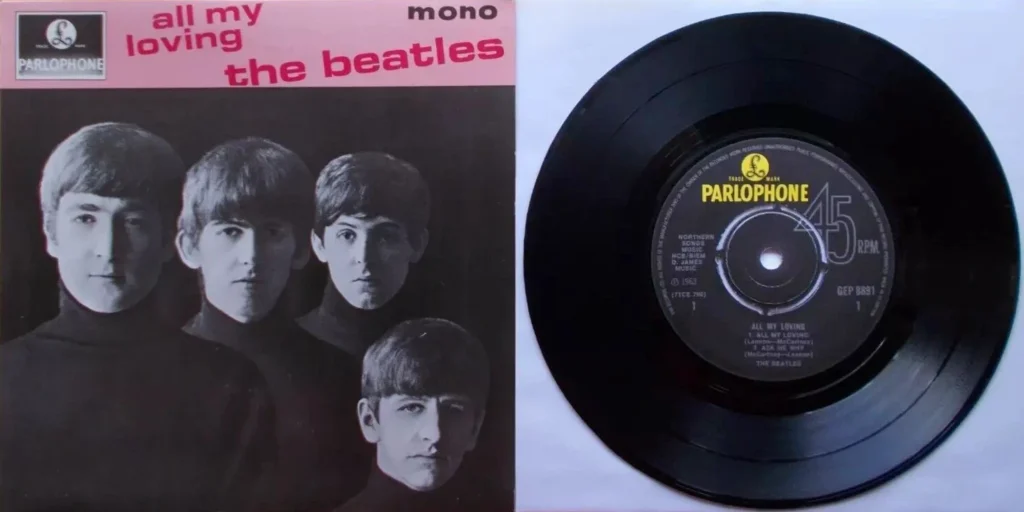
Fair Dealing Disclaimer: Low-resolution image used for identification, criticism, review, and historical commentary relating to the All My Loving EP sleeve and packaging. All rights remain with the copyright holder.
Where To Find The Songs
- “All My Loving” and “Money (That’s What I Want)” appear on With The Beatles.
- “Ask Me Why” and “P.S. I Love You” appear on Please Please Me.
Why The EP Still Deserves Its Own Page
The All My Loving EP is worth covering not because it introduced unheard Beatles material, but because it shows how EMI marketed the group at a crucial turning point. It packaged album tracks and B-sides as premium catalogue, trusted a non-single title to carry the release, and sent it into the shops on the same day the band arrived in America. That is not padding in the discography. It is a sharp little record-business snapshot of Beatlemania in motion.
Seen that way, the EP becomes more than a four-song stopgap. It is a neat summary of what the early Beatles had already achieved by February 1964: strong originals, powerful covers, recognisable sleeve branding, chart muscle, and enough public demand to turn previously released songs into another hit.
Have your own thoughts on the EP? Join the discussion in the Beatles Fan Club Forum.
Sources And References
- The Beatles – Official title-track page and UK airplay background.
- The Beatles – Official “Ask Me Why” release history.
- The Beatles – Official “P.S. I Love You” release history.
- Graham Calkin’s Beatles Pages – EP chart run, sleeve credit, and pressing details.
