
The Beatles’ Nowhere Man EP looks simple on the surface, but it says quite a lot about where the group stood in mid-1966. Released on 8 July 1966 as their twelfth official UK EP, it pulled together four songs from Rubber Soul at a point when that album was already well established and the Beatles themselves were moving on fast.
That is what makes the record worth covering. This was not a stopgap built from leftovers or oddments. EMI took four tracks from side one of Rubber Soul and turned them into a compact mono sampler built around some of the album’s most accessible and melodic material: Nowhere Man, Drive My Car, Michelle, and You Won’t See Me. That gave the EP a clearer identity than many album-derived releases.
Nowhere Man EP: Key Facts
- Released: 8 July 1966
- Type: Compilation EP
- Compiled From Recordings Made: 13 October to 11 November 1965
- Studio: EMI Studios, London
- Format: 7-inch vinyl EP, 45 RPM, mono only
- Length: 11:11
- Label: Parlophone (GEP 8952)
- Producer: George Martin
- UK EP Chart: No. 4
- Weeks On Chart: 18
Why It Matters
By July 1966, the Beatles were no longer the group of early EP quick wins and tidy beat boom packaging. They had already issued the Paperback Writer/Rain single and were weeks away from Revolver, so this record already had a slightly retrospective quality. It repackaged late-1965 material at a moment when the band were changing again.
That helps explain both its appeal and its limits. For buyers who could not afford the full album, the EP offered four strong Rubber Soul tracks at a cheaper price. But because none of them were exclusive, and because the Beatles had already moved artistically beyond this sound, the record feels less like an event than a neatly targeted pocket version of one side of the album.
It also helped that “Nowhere Man” had not been issued as a UK single, so the title track still gave British buyers a familiar song in a format they could not get outside Rubber Soul.
Performers And Lead Vocals
Because this is a compilation EP, the exact instrumental details vary from track to track. The broad pattern across the four songs is still the classic Rubber Soul-period line-up, led by Lennon and McCartney vocals and supported by Harrison’s increasingly distinctive guitar work.
- John Lennon – lead vocal on “Nowhere Man”, harmony and backing vocals, rhythm and lead guitar
- Paul McCartney – lead and co-lead vocals, bass guitar, piano
- George Harrison – harmony vocals, lead guitar, acoustic guitar
- Ringo Starr – drums, tambourine, percussion
- George Martin – producer
Nowhere Man EP Track Listing
Side One
- Nowhere Man – the title track’s three-part harmony statement of isolation and detachment
- Drive My Car – the tough, witty opener that launched Rubber Soul
Side Two
- Michelle – the soft, carefully shaped ballad that became one of the album’s best-known songs
- You Won’t See Me – the brisk, Motown-leaning relationship song that closes the EP strongly
Why The Song Selection Worked
The most interesting thing about the selection is that EMI lifted all four songs from side one of the UK Rubber Soul. That was not random. It meant the EP leaned towards some of the album’s most immediate material rather than its more eccentric or inward-looking tracks.
That gives the record its own shape. “Drive My Car” provides the sharp opening riff and attitude, “Nowhere Man” brings the close harmony and reflective lyric, “Michelle” supplies the gentler melodic centre, and “You Won’t See Me” adds energy again at the end. In effect, the EP works like a mini curated version of side one rather than a random four-song extract.
It is also worth noticing what EMI left off. Rubber Soul side one also contained “Norwegian Wood (This Bird Has Flown)“, “Think For Yourself“, and “The Word“, but those songs were all slightly odder or less immediately commercial. The EP therefore leans on accessibility, melody, and recognisable titles rather than the album’s more exploratory side.
That neat four-song logic is also specifically British, because the American Capitol version of Rubber Soul used a different running order and did not group these tracks together in the same way.
Cover Photo And Sleeve Design
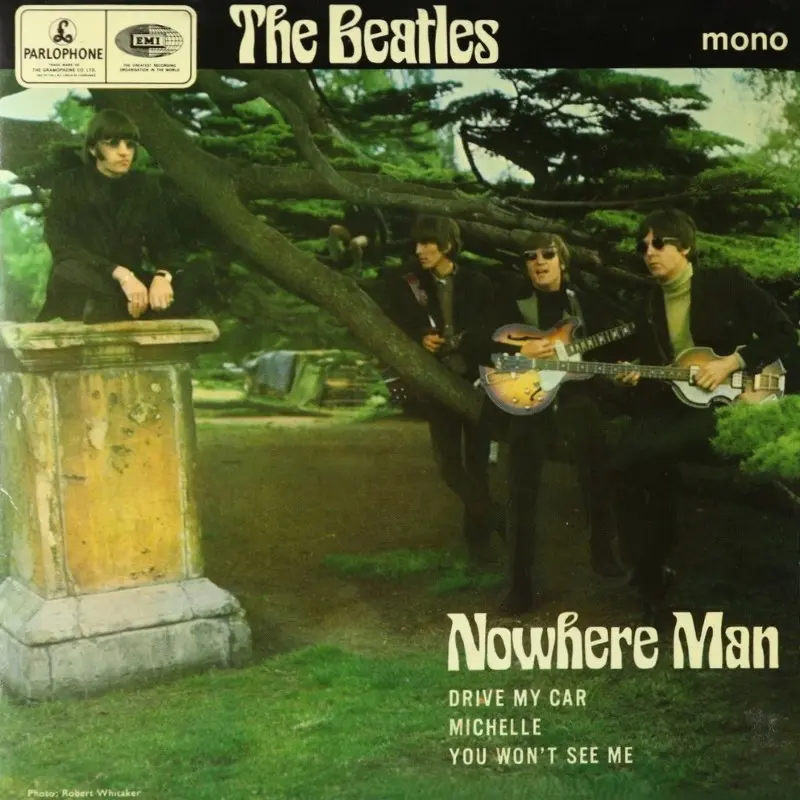
The sleeve is one of the record’s best features. Instead of another straightforward studio portrait, it places the Beatles outdoors in a dark, moody garden setting, with the leaning tree, deep green tones, and scattered poses creating a cooler and more detached atmosphere than many earlier EP covers.
The image feels less like cheerful pop packaging and more like a transitional Beatles photograph.
That matters because it suits the material. Rubber Soul already marked a more mature and self-conscious stage in the Beatles’ development, and this cover pushes in the same direction. Robert Whitaker’s photograph, taken from the Paperback Writer promo period, gives the EP a stronger visual identity than a routine album spin-off really needed.
Fair Dealing Disclaimer: Image used at reduced size for identification, commentary, and historical discussion; rights remain with the original rights holder.
Nowhere Man EP: Chart Success
Unlike some earlier Beatles EPs, this one did not reach the top of the UK EP chart. It peaked at No. 4, although it still remained in the chart for eighteen weeks. That is a respectable run, but it also tells you something useful about the market by mid-1966: even the Beatles could no longer treat an album-derived EP as an automatic chart-topper.
That performance makes the record more interesting, not less. It shows the limits of the EP format once fans had already bought the main album and the band were moving into a newer phase. In that sense, Nowhere Man is a useful marker of change. It still sold well, but it belonged to a format whose commercial power was beginning to soften.
Where To Find The Songs
- Nowhere Man – Rubber Soul and 1962-1966
- Drive My Car – Rubber Soul and 1962-1966
- Michelle – Rubber Soul and 1962-1966
- You Won’t See Me – Rubber Soul
Have your own thoughts on the EP? Join the discussion in the Beatles Fan Club Forum.
Sources And References
- The Beatles – Rubber Soul track list and album context.
- The Beatles – Nowhere Man recording details.
- J.P.G.R. – EP release, catalogue number, and chart run.
- Yokono – Cover photo and pressing notes.
