
The Beatles at Shea Stadium matters on BeatlesFan.Club because it is not just a film of a famous concert. It is the most important surviving screen document of the moment Beatlemania outgrew theatres and became stadium-scale spectacle. When The Beatles played Shea Stadium on 15 August 1965, they were not simply doing another American show. They were testing whether rock and pop could function in a venue built for major-league sport.
That is what gives the film its historical force. The television special turned a chaotic, barely audible live event into a lasting visual record of the touring years, and in doing so it helped define how later generations would picture The Beatles at their commercial peak.
The Beatles at Shea Stadium: Key Facts
- Filmed: 15 August 1965 at Shea Stadium, New York City
- First UK Broadcast: BBC1, 1 March 1966
- West German Broadcast: 2 August 1966
- US Broadcast: ABC, 10 January 1967
- Director and Producer: Bob Precht
- Production: Ed Sullivan Productions, NEMS Enterprises and Subafilms
- Cinematography: Andrew Laszlo
- Production Supervision: M. Clay Adams
- Cameras Used: 14
- Runtime: About 50 minutes
- Attendance At The Concert: 55,600
Why Shea Mattered Before The Film Existed
The Shea Stadium concert is often described as the first major stadium rock concert, and even where that claim gets debated in the small print, the broader point still stands: this was the show that made stadium-scale Beatles performance part of pop history. The band had played large venues before, but Shea fixed the image in the public imagination. It was huge, unprecedented by Beatles standards, and visually overwhelming.
That matters because the film is not documenting a routine stop on a tour. It is documenting the night The Beatles’ live act collided with a venue too big, too noisy, and too logistically awkward for the existing rules of pop performance. George Harrison later recalled that even the new 100-watt Vox amplifiers were not enough, while Ringo Starr remembered that the screaming drowned everything from the count-in onwards.
So the film preserves two stories at once. It shows Beatlemania at full stretch, but it also shows the practical limits of touring in 1965. In that sense, it belongs to the same wider story that eventually pushed The Beatles away from live performance altogether.
How The Beatles At Shea Stadium Was Shot
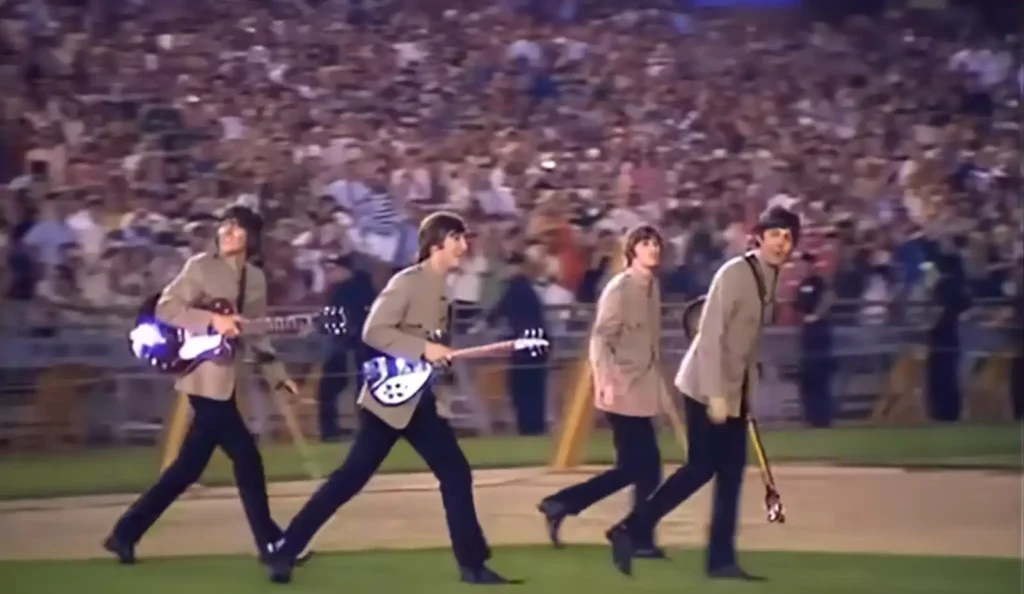
NEMS and Subafilms worked with Ed Sullivan Productions to turn the concert into a proper television event rather than a simple newsreel fragment. Under Bob Precht and production supervisor M. Clay Adams, a crew led by cinematographer Andrew Laszlo used 14 cameras to capture not just the songs, but the helicopter arrival, backstage movement, crowd hysteria, security struggle, and sheer scale of the stadium.
That production choice is one reason the film still matters. It was not interested only in the set list. It was interested in the phenomenon. The camera keeps returning to screaming fans, uniformed police, elevated crowd shots, and the strange distance between the band and their audience. In other words, it documents a mass cultural event as much as a concert.
What The Television Cut Changed
This is the detail too many fan pages blur past: The Beatles at Shea Stadium is not a fully untouched record of what happened on stage. The television special was heavily shaped in post-production. Two songs from the 12-song concert, “She’s A Woman” and George Harrison’s “Everybody’s Trying To Be My Baby“, were cut from the TV film.
The soundtrack was also repaired. On 5 January 1966, The Beatles went to CTS Studios in London to overdub parts for the film. Paul McCartney re-recorded bass for “Dizzy Miss Lizzy“, “Can’t Buy Me Love“, “Baby’s In Black” and “I’m Down“, while John Lennon added organ to “I’m Down”. More strikingly, the audio for “Twist And Shout” was replaced with sound from the 1964 Hollywood Bowl performance, and “Act Naturally” was swapped for a speeded-up studio recording edited to fit the footage.
That does not make the film fake. It makes it a polished television construction built from a real event that had been too loud and too chaotic to capture cleanly in the moment. For historians, that distinction matters.
The Beatles’ Set And What Survives
The original concert featured 12 songs, opening with “Twist And Shout” and ending with “I’m Down”. The film preserves most of that run, including “I Feel Fine“, “Ticket To Ride“, “A Hard Day’s Night” and “Help!“. Even in altered form, the performances still show how tight the band could be under dreadful sonic conditions.
One especially important survival is Harrison’s Shea performance of “Everybody’s Trying To Be My Baby”, which was cut from the television special but later surfaced on Anthology 2 from the unedited Shea soundtrack. That matters because it proves the original concert exists in fuller form than the broadcast version suggests, even if the complete authorised film still remains elusive.
The opening material is also part of the appeal. The helicopter arrival, the armoured-van style transport to the stadium, and Ed Sullivan’s introduction all help explain why the film works as a portrait of Beatles fame, not just Beatles music.
Broadcasts, Cinema Showings, And The Long Afterlife
The film first reached viewers in Britain on BBC1 on 1 March 1966, then turned up in West Germany in August 1966 and on American television in January 1967. It was also shown in US cinemas, with promotional artwork designed by Klaus Voormann. That last detail is often missed, but it shows how the film was treated as more than disposable television.
Over time, the full special became strangely hard to access officially, even while parts of it kept reappearing. Footage turned up in The Beatles Anthology, in Ron Howard’s The Beatles: Eight Days A Week – The Touring Years, and in official Beatles clips shared much later. In other words, the material never vanished, but the original television film never settled into a normal home-video life either.
Rights, Lawsuits, And Why There Is No Straightforward Official Release
The legal history helps explain why the film has spent decades in a half-available state. Bootlegs circulated for years, and rights questions later erupted when footage from Shea was used in the 2016 touring documentary. In 2017, Apple Corps and Subafilms won a US copyright case brought by Sid Bernstein Presents, with the court ruling that Bernstein’s contract reserved no rights in the filming or recording of the concert.
That ruling mattered because it reaffirmed Apple/Subafilms control over the master tapes and confirmed that the famous concert footage remained a tightly controlled asset. So when unofficial uploads circulate, they are not filling a vacuum of abandoned material. They are circulating around footage whose ownership has been actively defended.
Take A Look
Watch The Beatles run out onto the Shea Stadium stage.
Prefer not to accept optional cookies? Open the official Shea clip on YouTube.
Final Verdict
The Beatles at Shea Stadium remains essential because it captures the point where the Beatles’ touring life became too big for the old rules. It is not a perfect live document, and the patched soundtrack means it should never be treated as a completely pure concert film. But that is also part of what makes it historically revealing.
This is a television special trying to wrestle an unprecedented pop event into a form that viewers could actually follow. It records the screams, the distance, the chaos, the technical problems, and the sheer scale of the band at their commercial summit. For that reason alone, it deserves a proper place in Beatles screen history.
Fair Dealing Notice: This article contains factual commentary and critical review for educational and historical purposes. All rights to The Beatles at Shea Stadium remain with the original rights holders, including Apple Corps, NEMS Enterprises, Subafilms and associated producers.
Sources And References
- The Beatles – Official film overview and historical comments.
- The Paul McCartney Project – Broadcasts, omitted songs, cinema notes.
- The Paul McCartney Project – January 1966 soundtrack repairs and overdubs.
- ABC News – 2017 ruling on ownership of Shea footage.
