
“Yes It Is” is the B-side to “Ticket To Ride”, but it is much more than a forgotten flip side. Released in April 1965, it gave John Lennon one of his most delicate early ballads and let the Beatles build some of the richest three-part harmonies of their middle period around a lyric of jealousy, memory, and emotional retreat.
That is why the song matters. Lennon later admitted he had been trying to write another “This Boy”, George Harrison’s volume-pedal guitar gave the track its haunted colouring, and the Beatles spent five hours shaping it in the studio – longer than any other song they recorded in 1965. It also has a strange release history, from the US single’s mistaken Help! film reference to the fact that a true stereo mix stayed largely hidden until much later.
Key Facts
- Release Date: 9 April 1965 (UK), 19 April 1965 (US)
- Format: 7-inch single B-side to “Ticket To Ride”
- Recorded: 16 February 1965
- Recording Studio: EMI Studios, London
- Genre: Rock, pop ballad
- Track Duration: 2:41
- Label: Parlophone
- Songwriters: Lennon-McCartney
- Producer: George Martin
- Engineer: Norman Smith
- Notable Outtake: Takes 2 and 14 on Anthology 2
Performers And Instruments
- John Lennon: double-tracked lead vocals, acoustic rhythm guitar
- Paul McCartney: harmony vocal, bass guitar
- George Harrison: harmony vocal, volume-pedalled lead guitar
- Ringo Starr: drums, tambourine
Where To Find “Yes It Is”
The original version first appeared as the B-side of “Ticket To Ride”. It later turned up on Past Masters, which gave it a more natural home among the non-album singles and B-sides, and on Anthology 2, which includes a composite outtake built from takes 2 and 14. In the United States, it also appeared on Beatles VI.
- 7-inch single B-side to “Ticket To Ride” – original 1965 mono single version
- Beatles VI – US album appearance, issued by Capitol in Duophonic fake stereo
- Past Masters – non-album catalogue version, the main modern home for the master
- Anthology 2 – composite outtake from Takes 2 and 14, not the released master
Background And Meaning
“Yes It Is” sounds gentle, but the lyric is not. Lennon’s narrator tells a new lover not to wear red because that colour brings back the memory of another woman. That is a sharp little emotional idea: love, memory, and grief compressed into a few repeated lines and carried almost entirely by the harmonies.
That is one reason the song stands out. It does not need a big dramatic story. Lennon takes one small trigger – a colour – and turns it into a wound that still has not healed. The result is a jealous and fragile song that hides its bitterness inside one of the prettiest arrangements on the 1965 single catalogue.
“This Boy”, But Darker
Lennon later said he had been trying to write another “This Boy” and felt that “Yes It Is” “didn’t quite work”. That judgement was far too hard on the song. What he really made was not a repeat of the earlier B-side, but a darker and more emotionally awkward follow-up. Where “This Boy” leans on smooth doo-wop sadness, “Yes It Is” sounds more suspended and uneasy.
Paul McCartney took the opposite view and called it “a very fine song of John’s”. He had a point. The chord movement is more adventurous than it first sounds, and the three-part singing is not simply sweet harmony for its own sake. The dissonances and shifting tensions are what give the record its ache.
The Harmonies Make The Record
The first thing many listeners notice about “Yes It Is” is the vocal blend. Lennon, McCartney, and Harrison create one of the Beatles’ most intricate harmony performances, and they recorded those harmonies live together after getting the basic track in place. That matters because it helps explain why the song feels so organic even when the chords grow unsettled underneath.
George Harrison’s volume-pedal guitar is just as important. He had already used the effect on “I Need You”, but here it sounds even more ghostly. Instead of a flashy solo, the guitar slides in and out of the song like a second emotional voice, shadowing the harmonies rather than competing with them.
Recording The Song
The Beatles recorded “Yes It Is” on 16 February 1965 at Abbey Road during the first burst of sessions for the Help! period. They attempted 14 takes of the basic track before they got it right, which is a striking detail because it made the song the most take-heavy Beatles recording of 1965.
That alone tells you the song was harder to land than its gentle surface suggests. After the rhythm track, Lennon, McCartney, and Harrison spent three more hours recording the vocal harmonies live together. George Martin reportedly encouraged them towards a barbershop-like balance, which helps explain why the finished record sounds so carefully interlocked.
There is another useful session detail here. On the same day, the Beatles also completed Harrison’s “I Need You”. That means two of George’s earliest volume-pedal guitar showcases were finished within the same session window, which makes “Yes It Is” an even better marker of the band’s growing interest in texture and tone rather than just straightforward beat-group playing.
The Stereo Oddity
“Yes It Is” has a more interesting mix history than many Beatles B-sides. For years, the true stereo mix stayed oddly obscure and did not turn up on the usual 1970s compilations. It first surfaced in a limited 1986 promotional release before becoming more widely available on Past Masters.
In the United States, the song’s stereo history was muddied further because Capitol used a Duophonic fake-stereo version on Beatles VI rather than a true stereo mix. That is why older listeners often knew the song mainly in mono for far longer than they realised.
That mix history also explains one small quirk collectors notice. The stereo version has a tape dropout in the first verse and an extra volume-pedal guitar note under the opening “If”, which gives it a slightly different texture from the mono single. Those are small details, but they are exactly the sort of thing that makes Beatles recording history more interesting than a simple list of releases.
The American Single Error
One of the stranger bits of “Yes It Is” history is the American single label. Some US pressings wrongly stated that the song came from the film Eight Arms To Hold You, the original working title for Help! In reality, “Yes It Is” does not appear in the film at all.
That error is the sort of release-history oddity fan pages often miss. It also shows how tightly Beatles singles, films, and albums were being marketed in 1965, even when the paperwork did not quite keep up with the finished product.
Yes It Is: Single Success
Although “Yes It Is” was the B-side, it travelled on one of the Beatles’ biggest 1965 singles.
“Ticket To Ride” reached number one in the UK and became the band’s seventh consecutive UK chart-topper, while Official Charts also notes it was their third consecutive US number one. That gave “Yes It Is” huge exposure as the flip side of a major hit.
Sleeve description for review purposes: An image of the original UK Parlophone 45rpm single for “Yes It Is” by The Beatles. The black centre label sits inside a comic-strip style promotional sleeve with a Morphy-Richards hair booklet advert printed around the record.
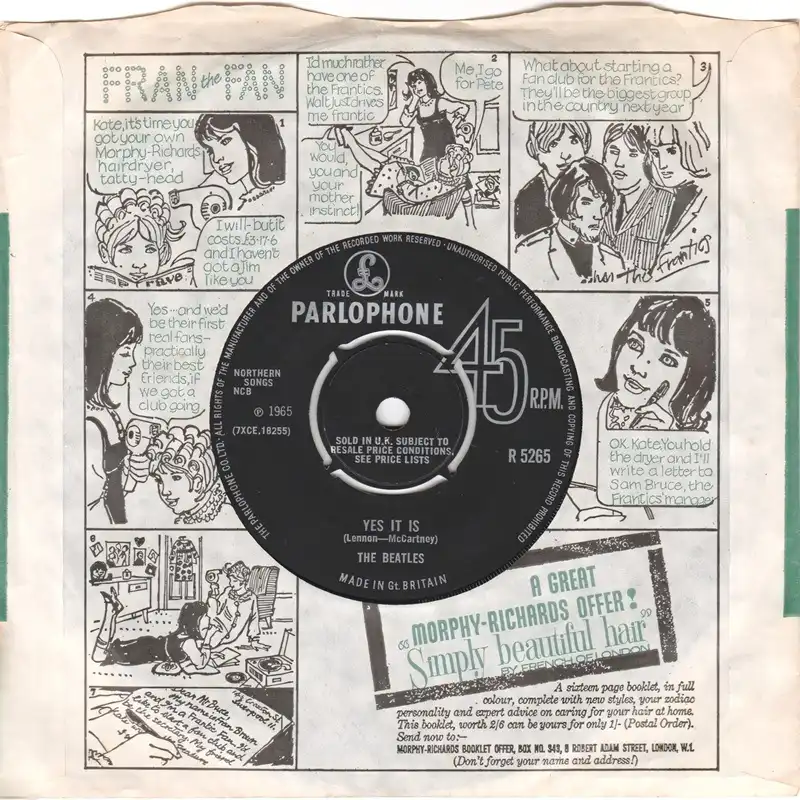
Fair Dealing Disclaimer: This image is used on BeatlesFan.Club for identification, commentary, criticism, review, and historical discussion of the “Yes It Is” single, label, and sleeve. It is shown in low-resolution form only to the extent needed for that purpose. Copyright and trade mark rights remain with their respective owners, and the use is intended to rely on fair dealing under UK copyright law.
Why “Yes It Is” Matters
It matters because it is one of Lennon’s finest early ballads, even if he did not fully trust it himself. The song sits in a fascinating place between the Beatles’ harmony-driven early style and the deeper emotional shading they were beginning to reach in 1965.
It also matters because it proves that a Beatles B-side could still contain first-rate work. “Yes It Is” was tucked behind “Ticket To Ride”, but it was no throwaway. Between the harmonies, the wounded lyric, and Harrison’s volume-pedal guitar, it carries far more beauty and tension than many more famous songs.
Take A Listen To “Yes It Is”
Play it again, then carry the discussion over to our Beatles Forum.
If you’d rather not load the YouTube player on this page, open the video directly on YouTube instead.
Sources And References
- The Beatles – Official song page and release details.
- The Beatles – Single context and B-side pairing.
- The Beatles – Official Anthology 2 Takes 2 and 14 listing.
- The Paul McCartney Project – Session details, stereo history, and US single error.
BeatlesFan.Club operates independently and does not affiliate with The Beatles, Apple Corps, or any official rights holders.
