
The Quarrymen matter because they were not just a schoolboy skiffle group that happened to come first. This was the band in which John Lennon learned to lead, in which Paul McCartney entered the picture, and in which the move from homemade skiffle to harder rock and roll began to take shape.
That is why their story deserves more than a quick pre-Beatles summary. The Quarrymen were the setting for the Lennon-McCartney meeting, the route by which George Harrison came in, the source of the first surviving studio recording by the future Beatles, and the bridge between Liverpool skiffle and the group that would become The Beatles.
Key Facts
- Founded: Liverpool, 1956
- Founder: John Lennon
- Name Origin: Quarry Bank High School
- Original Style: Skiffle, then increasingly rock and roll
- Most Important Turning Point: Paul McCartney meeting Lennon on 6 July 1957 at St Peter’s Church fete in Woolton
- First Famous Recording: 1958 acetate of That’ll Be The Day and In Spite Of All The Danger
- Why They Matter: The Quarrymen evolved, through several line-up and name changes, into The Beatles
How The Quarrymen Began
The Quarrymen were formed by John Lennon in Liverpool in 1956, during the great British skiffle boom. Like hundreds of teenage groups of the period, they started with cheap instruments, homemade rhythm, and a repertoire built from American folk, blues, country, and rock and roll records. What separated them from countless other skiffle outfits was not immediate greatness but the speed of their development.
The name came from Quarry Bank High School, where Lennon and several early members were pupils. In the beginning the group was loose, local, and changeable rather than fixed. Tea-chest bass duties passed between several friends before Len Garry became a key member, and the early line-up also included Eric Griffiths, Pete Shotton, Rod Davis, and Colin Hanton. That fluidity matters because it shows the Quarrymen were not born as a finished band. They were a teenage social circle turning itself into a working group.
Rosebery Street And The First Famous Photos
One of the most revealing Quarrymen episodes came on 22 June 1957 in Rosebery Street, Liverpool. The band played from the back of a coal lorry at a street event, and the surviving photographs from that day are commonly attributed to Charlie Roberts. Only three images of the performance are known to survive.
Those images are historically valuable because they are among the earliest known live photographs of Lennon performing with the Quarrymen, and they pre-date the Woolton church fete by roughly a fortnight.
That gives the Rosebery Street photographs more weight than they usually receive. They do not merely show an obscure pre-Beatles gig. They capture the group just before the moment when the story changes forever. In other words, they show the world John Lennon was already trying to build before Paul McCartney walked into it.
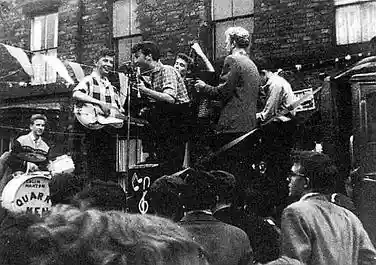
Image via Wikimedia Commons, licensed CC BY-SA 4.0. Photograph commonly attributed in Beatles-history sources to Charlie Roberts.
The Day John Met Paul
The single most important Quarrymen performance took place on 6 July 1957 at the St Peter’s Church fete in Woolton. That afternoon Ivan Vaughan introduced Lennon to Paul McCartney. The meeting has been told many times, but the detail that still matters is practical rather than romantic: McCartney impressed Lennon musically. He knew the words to current rock and roll songs, he could tune a guitar properly, and he looked like someone who would raise the group’s level.
That was the beginning of the Lennon-McCartney partnership, but it was also a Quarrymen story before it became a Beatles story. Without the fete booking, without the group following the parade through Woolton, and without Lennon already having a band worth joining, the meeting would not have carried the same force. The Quarrymen were the mechanism that made the introduction matter.
From Skiffle To Rock And Roll
Once McCartney joined, the Quarrymen began changing fast. They did not abandon skiffle overnight, but they became more serious about guitars, arrangement, and up-to-date rock and roll material. That shift was obvious enough at their first advertised appearance at the Cavern Club in August 1957, when their move toward rock and roll reportedly clashed with the venue’s jazz-minded expectations.
George Harrison’s arrival in early 1958 pushed the band further in the same direction. Lennon was initially reluctant because Harrison was so young, but his guitar ability made the difference. Harrison was not just another friend drafted in to fill space. He gave the group stronger lead playing at exactly the point when the Quarrymen were moving away from washboard skiffle and toward the style that would define the next phase.
Another often-overlooked figure from this period is pianist John “Duff” Lowe. He is crucial because he played on the 1958 acetate and belongs to the real history of the group’s first recording, yet many shorter retellings skip him almost entirely.
The 1958 Percy Phillips Recording
In July 1958 the Quarrymen paid 17 shillings and sixpence for a recording session at Percy Phillips’ small Liverpool studio at 38 Kensington. The result was the first surviving studio recording made by the future Beatles: a cover of That’ll Be The Day and the original In Spite Of All The Danger. Lennon sang lead on both tracks, with McCartney, Harrison, Lowe, and Hanton completing the line-up.
This session matters for more than simple firstness. “In Spite Of All The Danger” was credited to McCartney and Harrison rather than Lennon-McCartney, which makes it a rare glimpse into the songwriting partnership before its later professional identity had settled. The recording also preserves the Quarrymen at a specific transitional stage: no longer a casual skiffle act, not yet The Beatles, but already moving towards a band capable of making its own material part of the story.
The acetate itself became part of Beatles mythology. Only one disc was made, it passed from member to member, and John Duff Lowe eventually kept it for years before selling it back to Paul McCartney in 1981. That helped preserve one of the most important artefacts from the group’s earliest period.
The 1959 Bridge To The Beatles
By 1959 the Quarrymen were already becoming something else. On the opening night of the Casbah Coffee Club on 29 August 1959, the line-up of Lennon, McCartney, Harrison, and Ken Brown performed as the Quarrymen in the cellar of Mona Best’s house. That show belongs in any serious Quarrymen history because it sits directly on the threshold of the Beatles era.
From there the names became fluid: the Quarrymen, Johnny and the Moondogs, the Silver Beetles, and finally The Beatles. Stuart Sutcliffe‘s arrival on bass in 1960 completed another crucial step in the transformation. By then the original school-skiffle identity was fading, but it had not vanished completely. Some 1960 home recordings still sit in that overlap period, where the Quarrymen story and the Beatles story are almost impossible to separate cleanly.
Official Quarrymen Recordings And The Overlooked 1960 Demos
The 1958 acetate is the core document, but it is not the only officially released audio linked to the Quarrymen name. Anthology 1 also includes the 1960 home recordings “Hallelujah I Love Her So“, “You’ll Be Mine“, and “Cayenne“. These matter because they capture the group in its final transitional stage, and they are the only officially released Beatles recordings to feature Stuart Sutcliffe on bass.
That gives the Quarrymen a more substantial recorded legacy than some fan pages suggest. The discography is small, but it is historically dense. It covers the first studio acetate, early Lennon-McCartney writing, a rare McCartney-Harrison credit, and home recordings from the moment when the Beatles identity was almost formed but not fully settled.
Key Members And Why They Matter
- John Lennon: Founder, frontman, and the figure who turned a local skiffle group into the starting point of something larger.
- Paul McCartney: Raised the group’s musical level and became Lennon’s central songwriting partner.
- George Harrison: Added stronger lead guitar and accelerated the move away from skiffle.
- Eric Griffiths: One of the earliest core guitarists and part of the first real working version of the band.
- Pete Shotton: Early washboard player and one of Lennon’s closest friends from the original Quarry Bank circle.
- Len Garry: A key tea-chest bass player in the 1957 line-up and part of the Rosebery Street and Woolton period.
- Colin Hanton: The drummer on the crucial late-1957 and 1958 recordings.
- Rod Davis: Banjo player who represents the group’s genuine skiffle roots.
- John Duff Lowe: Pianist on the 1958 acetate and too important to be reduced to a footnote.
- Stuart Sutcliffe: Joined in 1960 during the final transition from Quarrymen identity to Beatles identity.
Why The Quarrymen Still Matter
The Quarrymen still matter because they show that the Beatles did not arrive fully formed. The future biggest band in the world began as a shifting teenage unit with cheap instruments, uncertain line-ups, local bookings, and a patchwork repertoire. That is not a weakness in the story. It is the story.
They also matter because the surviving evidence is unusually vivid. We have the Rosebery Street photographs, the Woolton meeting, the Cavern clash between skiffle and rock and roll, the Percy Phillips acetate, the Casbah link, and the final 1960 home recordings hovering on the edge of the Beatles era. Taken together, those moments make the Quarrymen one of the most important prehistories in modern popular music.
Where To Hear The Quarrymen
- Anthology 1 – includes “That’ll Be The Day” and “In Spite Of All The Danger”
- Anthology 1 – also includes the 1960 home recordings “Hallelujah I Love Her So”, “You’ll Be Mine”, and “Cayenne”
Here’s a short video worth watching and you can let us know your thoughts about the Quarrymen in the Beatles Fan Club Forum.
If you’d rather not load the YouTube player on this page, open the video directly on YouTube instead.
Sources And References
- The Beatles – Anthology 1 track listing and release details.
- The Beatles Story – Charlie Roberts and Rosebery Street photo history.
- St Peter’s Church – Woolton fete and John meeting Paul.
- The Paul McCartney Project – Percy Phillips session details.
BeatlesFan.Club operates independently and does not affiliate with The Beatles, Apple Corps, or any official rights holders.
