
This page is about the 1963 EP The Beatles No. 1, not the later 1 album. That matters because this was one of the Beatles’ earliest British EPs, issued while Beatlemania was still building rather than after the group had become a global institution.
The Beatles No. 1 was released in the UK on 1 November 1963 as the group’s third British EP. Like Twist And Shout, it pulled four songs from Please Please Me. However, this was not just another cheap sampler. It was a compact record that quietly captured several useful truths about the early Beatles: how quickly EMI learned to repackage the catalogue, how strongly the debut album still sold, and how even an EP built entirely from familiar tracks could become a chart event.
The Beatles No. 1 EP: Key Facts
- Release Date: 1 November 1963
- Format: 7-inch vinyl EP, 45 RPM, mono only
- Catalogue Number: Parlophone GEP 8883
- Tracks: Four
- Recording Dates: 11 and 20 February 1963 at EMI Studios, London
- Running Time: 9:59
- Producer: George Martin
- Sleeve Notes: Tony Barrow
- Sleeve Photo: Angus McBean
- UK Chart Performance: Number 2 on the EP chart; 29 weeks on chart
Why The Beatles No. 1 EP Mattered
The obvious criticism is easy enough: there were no new songs here. However, that misses the point of British EPs in late 1963. They were cheaper than LPs, still important enough to chart separately, and useful for labels trying to sell more music to an audience moving faster than normal release patterns could handle. By November 1963 Beatles demand was strong enough that EMI could take four album tracks, present them in a new sleeve, and still expect serious sales.
This EP also shows how quickly the Beatles’ catalogue had become marketable in multiple forms. Their first EP, Twist And Shout, also came entirely from Please Please Me. The Beatles No. 1 went even further by simply lifting the first four tracks from the LP in the same running order. That is such a literal selection that it makes the title look almost like EMI flirting with a numbered EP series it never properly continued.
Track Listing
Side A
Side B
What The EP Actually Offered
One of the most useful things about this EP is its structure. Side one contains two Lennon-McCartney originals, while side two turns to two cover versions from the Beatles’ stage repertoire. In other words, the record almost works like a demonstration disc for the early group: here are the songs they were writing themselves, and here is the kind of American material they could still tear into with conviction.
That split gives the EP more shape than some fan pages recognise. “I Saw Her Standing There” is the explosive opener that announced the Beatles’ confidence from the first count-in. “Misery” is shorter, tighter, and more inward-looking. Then side two flips to Arthur Alexander’s “Anna (Go To Him)” and the Cookies’ “Chains”, reminding listeners that the early Beatles did not grow only from self-written pop but also from deep listening to American soul and girl-group records.
Performers And Recording Details
- John Lennon: lead vocal on “Anna (Go To Him)”, co-lead vocal on “Misery”, backing vocals, rhythm guitar
- Paul McCartney: lead vocal on “I Saw Her Standing There”, co-lead vocal on “Misery”, bass guitar
- George Harrison: lead vocal on “Chains”, lead guitar, backing vocals
- Ringo Starr: drums
- George Martin: piano on “Misery”
That line-up matters because it gives each Beatle a visible role in the package. McCartney opens the record with one of the strongest early Beatles performances, Lennon dominates the emotional weight of “Anna”, Harrison gets a lead vocal showcase on “Chains”, and Martin’s piano on “Misery” adds one of the neatest production touches on the debut album sessions.
Why The Chart Run Was More Interesting Than It Looks
The Beatles No. 1 entered the UK EP chart on 9 November 1963, reached number 2, and stayed on the chart for 29 weeks. On paper that may look slightly weaker than the first two Beatles EPs. In reality it says something more interesting: the record was kept off the top by another Beatles EP, The Beatles’ Hits. That meant the group effectively blocked themselves from number 1.
In other words, this became the first official Beatles EP not to reach number 1, and it missed the top only because another Beatles EP, The Beatles’ Hits, was already there.
That detail matters because it helps place this EP inside the broader chart domination of late 1963. The Beatles were no longer competing just with other acts. They were increasingly competing with their own catalogue. By December 1963 they would hold the top two positions on the EP chart while also dominating the singles and album charts, and The Beatles No. 1 was part of that wider takeover.
The Beatles No. 1 EP: Sleeve And Packaging
The sleeve is one of the smartest bits of early Beatles repackaging. It reuses another Angus McBean image from the same EMI House stairwell session that produced the Please Please Me cover, but the steeper diagonal lines, the bolder red title, and the blunt “No. 1” badge give it a different mood.
Instead of simply repeating the LP artwork, it turns a familiar photo session into a fresh sales pitch, making the EP look like a confident sequel rather than a leftover bundle of album tracks.
Collectors pay attention to more than the photo. First pressings came in mono only with a laminated flipback sleeve, push-out centre, and embossed KT tax code, using matrix numbers 7TCE 764-1N and 7TCE 765-1N.
Original labels began with “The Parlophone Co. Ltd.” and used “Recording First Published 1963”, while later pressings altered those details and often look thinner and less sharply printed.
That kind of detail matters because Beatles EPs were treated as proper catalogue items, not cheap throwaways.
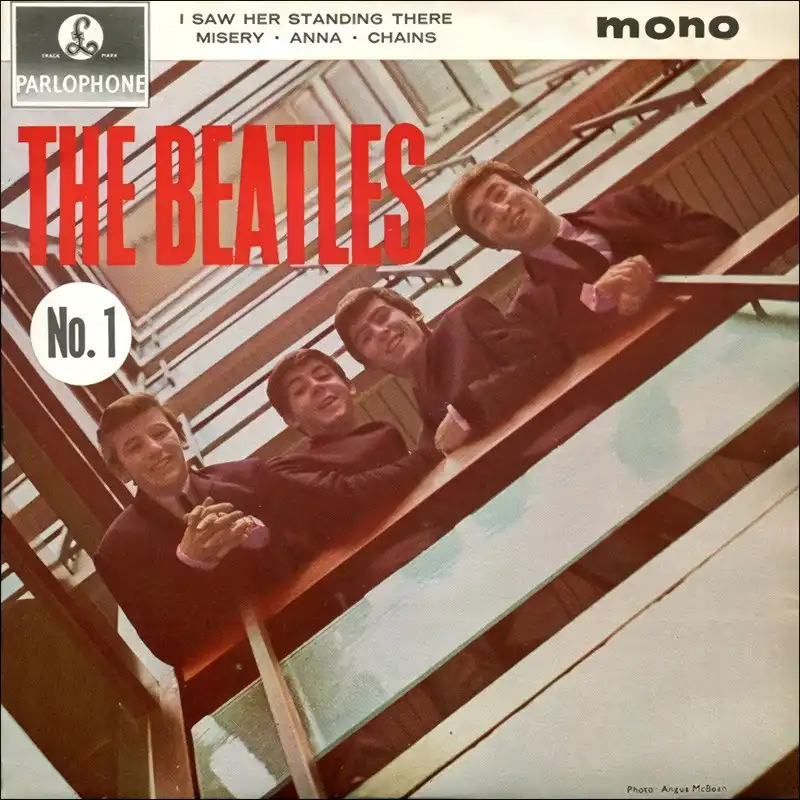
Fair Dealing Disclaimer: Low-resolution image used for identification, criticism, review, and historical commentary relating to The Beatles No. 1 EP sleeve and packaging. All rights remain with the copyright holder.
Where To Find The Songs
- All four tracks appear on Please Please Me.
- “I Saw Her Standing There” later appeared on the US single with “I Want To Hold Your Hand“.
- “Anna (Go To Him)” and “Chains” later appeared on the US album The Early Beatles.
Why This EP Still Deserves Its Own Page
The Beatles No. 1 is worth covering because it shows EMI learning how to squeeze more value from the Beatles’ first album without doing it lazily. The label did not just toss four random songs onto a disc. It took the first four tracks in sequence, gave them a new McBean sleeve, sold the package under a boastful title, and released it into a market already so hungry that another Beatles EP kept it from number 1.
Seen that way, the record becomes more than a four-song extra for collectors. It is a compact document of how fast Beatlemania was expanding in late 1963, and a reminder that even the smaller Beatles releases can reveal details about marketing, sequencing, image-making, and chart power that the headline albums and singles do not always show so clearly.
Have your own thoughts on the EP? Join the discussion in the Beatles Fan Club Forum.
Sources And References
- The Beatles – Please Please Me album page and Angus McBean cover background.
- The Beatles – I Saw Her Standing There release details.
- The Beatles – Anna (Go To Him) song background.
- Graham Calkin’s Beatles Pages – EP chart, matrix, and pressing details.
